This text is memeware:
if you find your copy useful, please propagate it.
See 0.7 Copyright.
Copyright. This text is the copyrighted property of the
author. Certain forms of copying are permitted and even
encouraged;
see the Copyright section for details.
PositionsThis text aims to assert humanity's analyses and theories that are most valid (i.e. convincing and defensible, as opposed to merely logically well-formed). These analyses and theories are not necessarily the most widely-believed or well-known. Potentially contentious assertions are those sympathetic to ontological materialism, epistemological empiricism and positivism, mental functionalism, theological atheism, axiological extropianism, political libertarianism, economic capitalism, constitutional federalism, biological evolutionism, and technological optimism.
Relatively uncontentious assertions appear as normal text. Potentially contentious assertions appear like this. Denials of widely-held beliefs appear like this.Questions whose answers lie outside human knowledge appear like this.
InnovationsAlmost all of the facts and analyses asserted in this text have of course been asserted before by other humans. Nevertheless, there are some things in this text that the author believes may be novel or at least independently original.
Arrangements. The text places various unoriginal pieces of information into some arrangements that might not have been presented elsewhere before. Among these are
Science is about truth that is not necessary but rather contingent, because it is based on actual observations and inductions about regular or pattern-following phenomena in the universe. The truths of science should be agreed upon by any thinkers in the universe that observe the same regular phenomena. The most interesting known phenomena in the universe are those concerning persons, and so science is divided accordingly. Natural science studies regular phenomena that do not necessarily involve persons and thus are likely to be universal (although many details of terrestrial life science are inevitably parochial). Technology applies mathematics and science toward accomplishing goals. Technological principles are likely to coincide wherever in the universe there are thinkers dealing with similar phenomena and desiring similar goals. Social sciences strive to induce truths that would apply to any kind of person anywhere in the universe, but this is not always possible because humans know of only one kind of person: humans. Most parochial of all would be topics relating to human arts and leisure, which this text excludes as not involving fundamental knowledge.
This text is memeware. You may reproduce or distribute this text only in complete and unmodified copies, only for non-commercial purposes, and only if you agree to the following memeware license.
If you find this text useless, you owe the author nothing. If you find it useful, you should do one or both of:The author believes and intends that this text violates no existing copyrights. Any quotations, data, or images from copyrighted sources are indicated and are cited under fair use. The cover's underlying image of the Earth is copyright The Living Earth, Inc.
- Propagate copies of it (complete with this memeware license) to at least two people who find it useful and do not yet have a copy, and email the author (brian@holtz.org) some vague indication of who they are.
- Pay the author however much the text is worth to you, via the payment link at http://humanknowledge.net. If the amount ($5? 5¢? 0¢?) is much less than the effort of sending it, then add the amount to your next charitable donation and advise the author of the charity and the amount.
The number of possible valid human knowledge summaries no longer than this text is immense but finite. This text is certainly far from being the best possible such summary. If the goal of approaching such an optimal summary is worthwhile, then an effective method might be to first produce a suboptimal summary and then to continually correct it or replace it outright with better ones. Thus corrections and replacements of this text are welcome.
At the end of this text is a list of some of the references used in writing it. Because this text attempts to say so much, it contains few references for particular statements. The text tries to explain or justify some of its statements, but most it merely asserts, due to space constraints.
Words in single-quotes are being mentioned rather than used. ('Ten' is a word, while ten is a number.) Words in double-quotes are being used verbatim from some source. Words in italics are being used with emphasis. Words in bold and used at the beginning of a sentence are being defined.
Necessary QuestionsPhilosophy asks the questions:
Autocosmic AnswersWhat is existing? Reality consists ultimately of matter and energy and their fundamentally lawlike and unwilled relations in space-time. To exist is to have a causal relationship with the rest of the universe. The universe is the maximal set of circumstancesthat includes this statement and no subset of which is causally unrelated to the remainder. Humans do not know why the universe exists or what it is for. The universe operates without supernatural intervention and according to lawlike regularities that can be understood through empirical investigation and without special intuition. Humans have no credible evidence of any supernatural agency or unity. Humans have no credible evidence that any minds enjoy eternal existence.
What is knowing? Knowledge is justified true belief. Truth is logical and parsimonious consistency with evidence and with other truth. Meaning is the context-sensitive connotation ultimately established by relevant denotation and use. All synthetic propositions (including this one) can only be known from experience and are subject to doubt. A synthetic statement is propositionally meaningless if it is in principle neither falsifiable nor verifiable. A mind is any volitional conscious faculty for perception and cognition. Minds and ideas consist ultimately of matter. Mental states are functional states consisting of causal relations among components for processing information. Consciousness is awareness of self and environment. Intelligence is the ability to make, test, and apply inductions about perceptions of self and world. There are no forms of reasoning or kinds of knowledge that are in principle inaccessible to regular intelligence.
What is good? As autonomous living intellects, we persons value intelligence and life and the autonomy they need to flourish. A person is any intelligent being with significant volitional control over how it affects other beings. All persons have the right to life and liberty. All beings have the right not to suffer torture or extinction. Liberty is volition in the absence of aggression. Aggression consists essentially of 1) coercion or 2) damage to a person's body, property, or rightful resources. Coercion is compulsion of one person by another through force or threat of aggression. Justice is the minimization, reversal and punishment of aggression. The purpose of the state is to effect justice, provide aid and sustenance to persons in mortal danger, protect species in danger of extinction, and prevent torture.
Autocosmology is a synthesis of metaphysical naturalism, ontological materialism, epistemological empiricism and positivism, mental functionalism, theological atheism, axiological extropianism, political libertarianism, economic capitalism, constitutional federalism, biological evolutionism, evolutionary psychology, and technological optimism. Autocosmology is the worldview asserted by this text.
Human AnswersMost humans justify their answers to philosophy's questions using one of four methods.
A skeptic believes what he sees. A mystic believes what he feels. A fideist believes what he hears. A cynic believes nothing. Thus faith fails in not questioning others, and mysticism fails in not questioning the self. Skepticism succeeds by exempting nothing from questioning, while cynicism fails by exempting no answer from disbelief.
Darwin made faith essentially indefensible among Western philosophers. Modern Western philosophy is broadly divided into two traditions, each of which starts with skepticism and takes it to a certain extreme.
RealityReality is everything that exists. Reality consists ultimately of matter and energy and their fundamentally lawlike and unwilled relations in space-time.
Theories of RealityThe primary distinction in theories of reality is between Nature and Spirit.
Deists retreat directly to the last trench, and use God only to answer the question of why there is something rather than nothing. Deism is unparsimonious, because it cannot answer the question of why there is God rather than not God.
Mystics usually believe in pantheism or outright idealism.Pantheism and Idealism are incorrect because they too are unparsimonious. They infer spiritual aspects of reality from psychological phenomena that can be explained more parsimoniously in materialist terms.
Skeptics usually believe in naturalism. The varieties of naturalism differ primarily according to their explanation of how matter relates to mind. While naturalists do not know why the universe exists, there is no credible evidence or convincing argument that its existence implies supernatural agency. Parsimony demands that supernatural agency be held not to exist until shown otherwise. Agnosticism constitutes either ignorance of this demand, or a redundant restatement of the principle that synthetic propositions are subject to doubt.
ParanormalityMany humans believe in the existence of phenomena which lie outside the materialist reality of natural science. The phenomena alleged include:
Understanding of reality and existence is built up according to experience from elements provided by logic: terms, their properties and relations, and the attributions and inferences that can be made among them. From these can be derived the ontological notions of causality, existence, time, identity, and space.
CausalityA circumstance is a set of terms and their fixed properties and relations that as a whole can be distinguished from other such sets and identified with itself. A change is a relation between an ordered pair of distinguishable circumstances and is defined by the two circumstances that it relates. An effect is a change that can be attributed. A cause is that to which an effect can be attributed in whole or in part. An influence is that to which an effect can be only partly attributed. Attribution is a fundamental concept that underlies the notions of both ontological causality and logical properties.
A necessary cause is one which can be inferred from the effect. A sufficient cause is one from which the corresponding effect can be inferred. To determine is to be the necessary and sufficient cause for. Possibility is the property of not being contradicted by any inference. Logical possibility is the property of not contradicting the laws of logic. Physical possibility is the property of not contradicting the laws of nature.
Is causality an illusion? Does every effect have a cause, or do some effects have no cause? Can there be a cycle of causality, in which an effect both precedes and contributes to its cause? Can one know the answers to these questions?
ExistenceThe universe is the maximal set of circumstances that includes this statement and no subset of which is causally unrelated to the remainder. To exist is to have a causal relationship with the rest of the universe. An entity is any term that exists. Two circumstances are causally unrelated if neither could ever influence the other.
It is unparsimonious to say other universes exist. One could imagine a set of circumstances causally unrelated to the maximal set that includes this sentence, and could choose to consider it a separate universe. But to say those imagined circumstances "exist" is to cheapen existence from causal reality to mere imaginability. An imagining does not establish the existence of the thing imagined.
Why is there something rather than nothing? Is there an objective purpose for that which exists? How could one recognize an answer to these questions? Are these questions meaningless?
Humans do not know why there is something rather than nothing, or if the question is even meaningful. If this question has a parsimonious answer, it must consist in a self-explaining fact or cycle of facts. A candidate for such a fact would be the concept of God in the Ontological Proof, but that proof is not convincing. Humans do not know any such fact(s), or even if they could possibly exist. If it is asserted that non-existence is more likely or natural than existence, one could ask why this asserted tendency (toward non-existence) itself exists.
A possibly meaningful (but unparsimonious) answer to the Ultimate Why is that the universe exists (more precisely, is perceived to exist) roughly because it is possible. The reasoning would be as follows. Absolute impossibility -- the state of affairs in which nothing is possible -- is itself not possible, because if nothing truly were possible, then absolute impossibility would not be possible, implying that at least something must be possible. But if at least one thing is possible, then it seems the universe we perceive should be no less possible than anything else. Now, assuming that physicalism is right and that qualia and consciousness are epiphenomena, then the phenomenology of a mind and its perfect simulation are identical. So whether the universe we perceive existed or not, it as a merely possible universe would be perceived by its merely possible inhabitants no differently than our actual universe is perceived by its actual inhabitants. By analogy, the thoughts and perceptions of a particular artificial intelligence in a simulated universe would be the same across identical "runs" of the simulation, regardless of whether we bothered to initiate such a "run" once, twice -- or never.
Thus, the universe might merely be the undreamed possible dream of no particular dreamer.
TimeAn event is a change that cannot interestingly be subdivided into constituent changes. Time is the ordering of events according to the potential of some events to causally influence other events. If (as in this universe) causal influence propagates through space only at finite speed, then some events can be far enough apart in space as to be in principle unable to influence each other. In this case time is a partial order on events instead of a total order.
An instant is a point on a linear continuum onto which events have been associated in a particular reference frame according to their order in time. Duration is a measure of the separation between two instants in time determined by counting intervening events of the kind that recur in proportional numbers to each other. Examples of such events are the swings of a pendulum or the vibrations of an atom.
Eternity is an entire linear continuum of instants. Thus by definition there is between any two instants another instant. However, it is not necessary that between any two events there is another event. Nor is it necessary that there be a first event, even if the past is of finite duration. Just as there is no smallest positive real number, there might be no first event, because there might be no event associated with a first instant (t=0). Instants are mathematical constructs that do not always have an associated actual event.
The future is, from the perspective of a particular event, the set of all events that the event potentially influences. The past is, from the perspective of a particular event, the set of all events by which the event is potentially influenced. The present is, from the perspective of a particular event, the set of all events simultaneous with it. Simultaneity is a relation enjoyed by two events if and only if they share identical sets of past and future events.
Hypertime. Time is often said to pass or flow or to be moved through. This metaphor of motion is misleading, because motion is spatial displacement over time, measured for example in meters per second. But a 'motion of time' measured in seconds per second is nonsensical, and so temporal displacement 'over time' requires a notion of hypertime, measured in seconds per hyper-second. This is no help, because hypertime too will be said to flow -- through hyper-hypertime. There is no reason to posit an absolute or universal or extra-temporal or distinguished present that flows or passes or marches and continuously turns absolutely future events into absolutely past ones. Past, present, and future are relations with a particular event and are not absolute properties in themselves.
Changing the future. The present can affect a future event, but it cannot "change" a future event. An event is itself a change and time is no more than an ordering of these changes. If changes themselves can change, these hyper-changes are hyper-events that can be ordered into hypertime. Events cannot change over time because events are defined by their pre- and post-conditions. To talk of different post-conditions for an event is really to talk of a different event, just as to talk of different cardinality for a number is really to talk of a different number. This does not imply determinism, because determinism is a statement about inference and not about inevitability.
Determinism is the thesis that a sufficient knowledge of any particular set of circumstances could be used to completely infer any subsequent circumstance. Some humans take determinism to be the thesis that the future is already decided, that the present was always going to be the way it is, that statements about probability and possibility are merely statements about one's incomplete knowledge, and that only actual possibility is that which is already inevitable.
Such a notion of ontological determinism is different from epistemic determinism only if there is a hypertime in which different points of normal time can "already" coexist. A notion of ontological determinism that is strictly different from epistemic determinism can have no practical consequences. As a difference that makes no difference, ontological determinism is a thesis that parsimony demands be rejected. Adopting the thesis makes as much sense as adopting the thesis that the universe is five minutes old. It is inconsequential -- and thus meaningless -- to say the future is already decided.
Some humans argue that if determinism is true, then no argument is to be considered valid as it is simply a train of statements following a predestined track. First, this misconceived argument applies as well to itself as it does to any other argument. Second, even in a deterministic system there can arise processes that tend to produce certain results. If viable organisms can arise, reproduce, and evolve due to natural selection in a deterministic universe, then surely viable arguments can arise, reproduce, and evolve due to competition in a marketplace of ideas. The viability of an idea or argument is closely related to its epistemological validity, and so the opposite misconception could occur: an argument might be considered more valid merely because it is at the end of so many predestined tracks.
Time Travel. Time travel would imply the existence of either hypertime or circular causality. Humans have no reason to think either exists.
Temporal Anisotropy. In a short video clip showing two billiard balls bouncing off each other, forward and backward in time are indistinguishable if one ignores friction and inelasticity. In a longer video of a billiards break, the future is the end in which the balls are no longer in a nicely ordered triangle. If causes can be attributed to effects as easily as effects can be attributed to causes, then causal laws do not distinguish past and future, and the future for an event is the direction of increasing disorder in the system. Traces and memories of the past are a localized increase in order at the expense of an increase in system-wide disorder. Due to statistical considerations, some systems can cycle between order and disorder. In such systems the direction locally considered to be future can vary over the timeline of the system.
Temporal anisotropy is not determined by the expansion of the universe, nor by the direction of electromagnetic radiation. For electromagnetism, the attribution of influence works equally well in both time directions. There is no inherent difference between the absorption and emission of a photon. Boundary conditions are logically possible in which photons are set in motion without having been emitted from anything, and which converge in shrinking spheres on an anti-emitter.
IdentityIdentity is the relation that obtains between two entities (or terms) that are the same instance, i.e., that could never be counted as two. Leibniz's Principle of the Identity of Indiscernibles states that if there is no possible way to distinguish two entities then they really are the same entity.
A given entity is identified through time with its closest close-enough continuous-enough continuer. A continuer is an entity which is similar to a previous entity and exists because of it. A continuer is close enough if it retains enough of the original entity's properties. A continuer is closest if it retains more of the original entity's properties than any other continuer. A continuer is continuous enough if there is no extraordinary discontinuity in its relationship to the original entity.
SpaceSpace is the seemingly boundless and continuous three-dimensional extent in which all matter is located and all events occur. It seems logically possible that space could be not only boundless (like the surface of a sphere) but infinite (like an infinite plane). It even seems logically possible that space could be locally discontinuous.
Do space and time have absolute existence independent of their contents? Or are they simply a system of relations among entities and events? Is there a way to answer these questions, or would any answer not make a difference?
GodGod is supernatural agency or unity, often considered necessary, perfect, timeless, omniscient, omnipotent, benevolent, and personal. A deity is a supernatural person, usually considered immortal, that demands or deserves human worship or reverence and that wields supernatural influence over human affairs.Divinity is the property of being supernatural and sacred. Sacredness is the property of being worthy of reverence or worship.
Humans have no credible evidence or convincing proof of any deities, including a God, Creator, First Cause, Perfect or Necessary Being.
Humans have proposed philosophical proofs of God as an alternative or supplement to historical revelation of God's existence.
AfterlifeMost humans believe that some form of reincarnation or immortality awaits them after death. Humans have no credible evidence of reincarnation or any kind of afterlife.
FaithFaith is belief based on revelation and exempt from doubt. Skepticism involves zero faith because it holds not even a single belief that is based on revelation and exempt from doubt. Skepticism holds that truth is not simply revealed but instead must always be subject to doubt, demonstration, and rederivation. This belief about truth is itself neither revealed nor exempt from doubt, but is instead subject to continual test.
It is possible (but unlikely) that this epistemological belief could one day stop yielding satisfactory results. For example, if God appeared and started violating physical laws, predicting the future, punishing infidels, and rewarding believers, then faith would suddenly be more satisfactory than skepticism. Until such a development, skepticism continues to be more satisfactory than faith.
Faith is not simply an absence of doubt, because tautologies are beyond doubt and yet are recognized not revealed. Faith is not simply any confident reliance on authority, because an authority can be relied upon even confidently without being held exempt from all doubt. Faith is not simply any provisional hypothesis believed without complete evidence, because a proposition can be provisionally believed without being held exempt from all doubt. Faith is not simply any affirmation of values, because to affirm a value is not to posit a proposition but to make a valuation. Faith is belief based on revelation and exempt from doubt. Fideists often say skeptics too have "faith" in science or reason, but this corrupts the definition of 'faith'. Faith must be embarrassing if its only defense is the claim that everybody is guilty of it.
Origin of faith. Humans' propensity for faith derives perhaps from their dependence on teaching by parents and society. In the absence of a biological mechanism for offspring to inherit knowledge directly, a predisposition for unquestioning belief in authority might help spare each generation from having to rediscover or verify everything.
MysticismMysticism is belief base on private and direct experience of ultimate reality. Mysticism holds that belief can be justified simply by the intensity or directness of an experience, and without a showing that the experience has any objective basis or consequences.
Rejecting objectivity and the distinction between the experiencer and the experienced, mysticism thus mistakes feeling for knowing. Mystics are forever free to claim that anyone who doesn't feel what they feel is somehow "doing it wrong". The conclusions of mysticism are usually unfalsifiable or inconsequential and thus propositionally meaningless.
Some mystics compare meditation to advanced mathematics and claim that both yield conclusions that can only be verified by adept practitioners. This claim is misleading. It is true that creating and even comprehending advanced mathematical conclusions usually requires specialized training. But all mathematical demonstration is by definition subject to verification through mechanical symbol manipulation. This symbol manipulation is not necessarily private or "interior" like the experience of a mystic, but is expressly public and exterior.
Origin of mysticism. Humans' propensity for mysticism derives perhaps from their nature as intelligent social animals who survive by detecting patterns and especially intentions in an environment dominated by their social interactions. Humans appear biased to see intentionality not only in friends, foes, predators, and prey, but also in weather, the heavens, or the universe itself. This bias is perhaps related to the general human tendency (known in psychology as the Fundamental Attribution Error) to incorrectly emphasize intentional explanations over situational or circumstantial ones.
ReligionReligion is any system of belief based on faith or mysticism, or involving worship of or reverence for some deity.
Science and Religion. A common misconception is that science might be an alternative to religion for answering questions about meaning and value. Those questions are the domain of philosophy, whereas science deals with objective phenomena. Science depends on the epistemological principle of skepticism, and any "conflict" between science and religion is really a conflict between skepticism and faith (or mysticism). Religion can be made superficially compatible with science by restricting itself to questions that are a) scientific but unanswered or b) philosophical. However, faith- or mysticism-based religion can never be compatible with the skepticism on which science -- and all epistemologically valid philosophy -- is built.
Belief SystemsMost humans attempt to understand the world through faith or mysticism. Of the major groups of believers, only agnostics and atheists avoid both faith and mysticism. This table summarizes the major human belief systems. Statistics on adherents are assembled from various sources, including Encyclopedia Britannica and adherents.com. The 'Deity' column identifies each system's type of supernaturalism , except that for monotheisms it instead names the deity. The 'Fate' column tells what each system believes happens to a person after death.
| Belief System | Millions | % | Where | When | Founder | Scripture | Deity | Fate |
| Christianity | 1960 | 34% | West | c30 | Jesus | New Testament | God | judged |
| Roman Catholicism | 981 | 17% | c30 | Paul, Peter | ||||
| Protestantism | 404 | 7% | ||||||
| Baptist | 100 | 2% | c1611 | Thomas Helwys | ||||
| Lutheran | 76 | 1517 | Martin Luther | (95 Theses) | ||||
| Anglican | 70 | England | 1534 | Henry VIII | ||||
| Episcopalian | 3 | USA | 1789 | |||||
| Methodist | 50 | 1738 | John Wesley | |||||
| Reformed | 1536 | John Calvin | (Institutes...) | |||||
| Presbyterian | ||||||||
| Pentecostal | 9 | USA | c1880 | Charles Parham | ||||
| Church of Christ | 1.6 | USA | c1832 | Campbell, Stone | ||||
| Society of Friends | USA | 1650 | George Fox | |||||
| Eastern Orthodox | 123 | 4% | 1054 | Michael Cerularius | ||||
| Mormonism | 11 | Utah | 1831 | Joseph Smith | Book of Mormon | |||
| Jehovah's Witness | 1.4 US | USA | 1878 | Charles Russell | ||||
| Christian Science | 0.4 | USA | 1879 | Mary Eddy | (Science & Health) | |||
| Islam | 1130 | 19% | Mideast | 600 | Muhammad | Koran | Allah | judged |
| Sunni | 16% | |||||||
| Shiite | 3% | |||||||
| Sufism | ||||||||
| (Agnosticisms) | 887 | 15% | non | death | ||||
| Hinduism | 793 | 14% | India | 1000 BCE | (Aryans) | Vedas, esp. Upanishads | poly | rebirth |
| Hare Krishna | ||||||||
| Buddhism | 325 | 5.6% | E. Asia | 525 BCE | Buddha | Tipitaka | pan | rebirth |
| Zen Buddhism | ||||||||
| Amidism | ||||||||
| (Atheism) | 222 | 3.8% | anti | death | ||||
| Chinese folk religions | 221 | 3.8% | China | |||||
| Confucianism | China | 500 BCE | Confucius | Analects; I Ching | non | death | ||
| Taoism | China | 550 BCE | Lao Tzu | Tao-Te-Ching | poly | immort | ||
| Asian New Religions | 106 | 1.8% | ||||||
| Animisms | 103 | 1.8% | ||||||
| Shamanism | ||||||||
| Voodoo | ||||||||
| Sikhism | 19 | 0.3% | Punjab | 1604 | Guru Nanak | Adi Granth | Sat-Kartar | rebirth |
| Judaism | 14 | 0.2% | Israel | 1800 BCE | Abraham | Old Testament | Yahweh | death |
| Spiritism | 10 | |||||||
| Bahaism | 6 | Persia | 1863 | Baha Ullah | Kitabi Ikan | Allah? | ||
| Jainism | 5 | India | 550 BCE | Mahavira | Purvas et al. | pan | rebirth | |
| Shintoism | 3 | Japan | <500 | (Japanese) | poly | commun | ||
| Cao Dai | 3 | Vietnam | 1919 | Ngo Van Chieu | God? | rebirth | ||
| Tenrikyo | 2.4 | Japan | ||||||
| Scientology | 1 | USA | 1954 | L. Ron Hubbard | Dianetics | (aliens) | immort | |
| Unitarianism | 0.8 | |||||||
| Rastafarianism | 0.7 | |||||||
| Zoroastrianism | 0.2 | Persia | 1000 BCE | Zarathustra | Avesta | Ahura Mazda | judged | |
| Parsee | 0.19 | |||||||
| Mandaeanism | 0.045 | Iraq | c300 | Haran Gawaita | mono? | immort | ||
| Other | 1.9 | |||||||
| Eckankar | USA | 1965 | Paul Twitchell | God | immort | |||
| Heaven's Gate | USA | 1971 | Marshall Applewhite | (aliens) | immort | |||
| Mithraism | Persia | |||||||
| Raelianism | France | 1973 | Rael | True Face of God | (aliens) | |||
| Rosicrucianism | West | 1614 | Johan Andrea | Confessio rosae crucis | ||||
| Santeria | Cuba | |||||||
| Satanism |
FideismsJudaism is the Semitic monotheistic fideist religion based on the Old Testament's (1000-600 BCE) rules for the worship of Yahweh by his chosen people, the children of Abraham's son Isaac (c1800 BCE).
Zoroastrianism is the Persian monotheistic fideist religion founded by Zarathustra (c628-c551 BCE) and which teaches that good must be chosen over evil in order to achieve salvation.
Christianity is the West Eurasian monotheistic fideist religion professing that Jesus of Nazareth (c6 BCE - c30 AD) is the descendent of Abraham and the Son of God whose sacrifice for humanity's sins was recorded in the New Testament (c50-100), and who fulfilled the prophecies of the divinely inspired Old Testament.
Islam is the Middle Eastern monotheistic fideist religion professing surrender to the will of Allah (God), whose revelations in the Old and New Testaments were superseded by the Koran revealed to Muhammad (c570 - 632-06) for his chosen people, the children of Abraham's son Ishmael (c1800 BCE).
Sikhism is the Punjab monotheistic fideist religion founded by Guru Nanak (1469-1539) and whose sacred Adi Granth (1604) overlays a spartan righteousness onto Hindu cyclical cosmology.
These religions place unwarranted faith in purported revelations for which there is no credible evidence of authenticity or validity.
MysticismsHinduism is the South Asian polytheistic mystical religion based on the Veda scriptures (c1000 BCE) and professing a cyclical cosmology, an ultimate reality called brahman, gods Vishnu and Shiva, and reincarnation of atman (soul) under the influence of karma.
Taoism is the Chinese polytheistic mystical religion based on the Tao-Te-Ching ascribed to Lao Tzu (c550 BCE) and which advocates a path (tao) of minimalist serenity and reverence for various deities.
Shintoism is the Japanese polytheistic mystical religion involving mainly the observance of customs and festivals honoring various deities.
Jainism is the Indian pantheist mystical religion founded by Mahavira (599-527 BCE) and which blends monastic asceticism with Buddhist cyclical cosmology.
Buddhism is the East Asian nontheistic mystical religion founded in India c525 BCE by the Buddha, who taught that existence is cyclical suffering caused by desiring and can be overcome by the "eightfold path" of right thought and deed.
Confucianism is the Chinese nontheistic mystical religion based on the sayings of Confucius (c500 BCE) recorded in the Analects, and which teaches social order, scholarship, filial reverence for family and ancestors, and divination.
These religions posit entities (such as gods or spirits or forces) to explain subjective mystical experiences which have simpler naturalistic explanations. These religions allege phenomena (such as rebirth and divination) for which there is no credible evidence. Of the belief systems in the world that currently have mass followings, Buddhism and Confucianism) are the least misguided. For this reason, thet are attractive to Westerners who recognize the bankruptcy of revelation-based religion but who are still looking for an off-the-rack worldview rather than learning enough philosophy to assemble one themselves.
Evidence For ChristianitySince Christianity is the most prevalent belief system among humans, it deserves special attention. The best evidence for the Christian doctrine of a divine Jesus is:
Naturalistic explanations. Jesus of Nazareth was a faith healer and self-proclaimed divinely-special savior who tried to reform his native Jewish religion. However, the evidence about Jesus is less likely to have resulted from divinity than from misinterpretation, exaggeration, rationalization, delusion, deception, and mythologizing. Indeed, perhaps the greatest weakness of the claims for Jesus' divinity is the gospels' reliance on and vouching for the Old Testament, a patchwork of folklore, legends and myths about a tribe whose patriarch Abraham turned to monotheism because of fertility problems. Jesus was a Jewish prophet who affirmed Jewish law [Mt 5:17-18; Lk 2:27,39; Jn 10:35], observed the Jewish calendar [Lk 4:16, Mt 24:20], and preached about the God of Israel [e.g. Mk 12:29] in Jewish synagogues [Mk 1:21, 1:39, 6:2; Mt 4:23, 9:35, 13:54; Lk 4:15, 4:44, 6:6, 13:10, 19:47; Jn 6:59, 18:20] exclusively for Jews [Mt 10:5, Mt 15:24]. Jesus no doubt echoed the Torah theme that "all nations" would witness the majesty of Israel's God, but his only command to actually convert and baptize "all nations" is in a post-Easter speech alleged only in one gospel [Mt 28:19] (and in an appendix later added to Mark [16:15]).
Miracles. In the gospels Jesus heals the sick (possession, blindness, skin disorder, bleeding, fever, paralysis, withered hand), revives the recently deceased, calms a storm, multiplies food, and walks on water. The miracles ascribed to Jesus seem not to have been very convincing [Mt 11:20, Lk 10:13, Jn 6:66, 10:32, 12:37, 15:24], and seem explainable by a combination of conventional faith healing, exaggeration, and mythologizing. The three people Jesus allegedly reanimates [Mk 5/Lk 8; Lk 7; Jn 11] might not actually have been clinically dead, and the gospels report not a single indication supporting such a diagnosis. Any cases of blindness, paralysis, or demonic possession cured by Jesus could have been psychogenic. Jesus apparently admits [Lk 11:24-26] that his cures for demonic possession are often not permanent, and in the synoptic gospels there is only one mention [Mt 21:14] of a cure being performed in Jerusalem. The one case of congenital blindness is recorded as disputed, and only in the latest gospel [Jn 9].
God? The Christian doctrine of the "trinity", attempting to reconcile Jewish monotheism with Jesus' self-revelation, holds that Jesus 1) is both fully human and fully divine, and 2) is God (in a different "person"). The former is a contradiction, and the latter has no scriptural basis. In the gospels Jesus never claims identity with God or even explicit divinity, but rather a divinely special status as "the Son of God" and the "Anointed One" (Hebrew: messiah; Greek: christos). Jesus repeatedly distinguishes himself from God:
The title of 'God' is never reliably applied to Jesus anywhere in the New Testament. (In many translations of 2 Pet 1:1 and Titus 2:13, the description "God and Saviour" is seemingly applied to Jesus, but the scholarly consensus regards these two letters as late and pseudoepigraphic.) Acts quotes [2:22, 2:36, 3:13, 10:38, 17:31] Peter and Paul describing Jesus in terms of a man appointed to an office, but never calling him God. The gospel authors never explicitly claim Jesus to be God, and the closest they come is the vague language of Jn 1: "the Word was God" and "became flesh". John quotes Thomas exclaiming [Jn 20] "my Lord and my God", but immediately states [20:31] as a creed merely "that Jesus is the Christ, the Son of God". The "mystery" of Jesus' nature was hardly clarified by the Apostles [e.g. Phil 2:6, Rom 1:4, Col 1:15, Col 2:9], whose epistles never claim Jesus has any kind of identity with God. (Christian scribes tried to change that; cf. the differing manuscripts for Rom 9:5, Acts 20:28, and 1 Tim 3:16.) Even the alleged angelic annunciation of Jesus to his parents ommitted [Lk 1:32, Mt 1:20, Mt 2:13, Mt 2:20] the claim that Jesus was Yahweh incarnate.
Thus, just as Jesus failed to leave clear teachings about salvation, hell, divorce, circumcision, and diet, he also did not effect a competent revelation of who precisely he was. Depending on e.g. various 4th-century Roman emperors, there waxed and waned such christological heresies as Ebionism, Docetism, Adoptionism, Dynamic Monarchianism, Sabellianism, Arianism, Marcionism, Apollonarianism, Nestorianism, Monophysitism, and Monothelitism. The doublethink of the "trinity" is not found in the Bible, but instead was invented to reconcile Jewish monotheism with Jesus' idiosyncratic Sonship claims.
"Son of God". Jesus seems to have been illegitmate, and to have been known to be such in his community [Mt 1:18-24, Jn 8:41]. His only recorded words before his ministry concern his disobedience [Lk 2:48,51] at age 12 to his mother and stepfather, whom he denied [cf. Mt 23:9] by calling the Temple "my Father's house". He spurned his stepfather's trade of carpentry to take up a ministry proclaiming himself the son not of Joseph but of God. Despite angelic revelations [Lk 1:32, Mt 1:20, Mt 2:13, Mt 2:20] to Mary and Joseph, Mary's knowledge [Lk 1:34] of the virgin conception, and Mary's witness of at least one miracle [Mk 2], they (and Jesus' siblings) did not believe in him [Jn 7:5, Mt 13:57] and thought him "out of his mind" [Mk 3:21], leading Jesus to repeatedly stress [Mk 3:33, 10:29; Mt 10:37, 12:48, 19:29; Lk 11:27-28, 14:26] that one should choose God over one's biological family. Only on the day of his death do the gospels record a single friendly word [Jn 19:26] from Jesus to his family.
Delusional Schizophrenic? Jesus began his (apparently one-year) ministry as a follower of John the Baptist (whose embarrassing baptism of Jesus is played down or not mentioned in the later gospels). In the earliest gospel (Mark), Jesus never calls himself Christ/Messiah, is reluctant for his special nature to be known, and (as he does in Matthew) despairs on the cross. (By contrast, in the later Luke and John, Jesus asserts he is Christ, and confidently assures a co-crucified convict of their impending ascension.) Jesus "could not do many miracles" in his hometown [Mk 6:5, Mt 13:58, Lk 4:24], and he at times was considered mad by other Jews [Jn 8:48, 10:20]. Jesus' movement seems not to have been joined in his lifetime by a single family member or prior acquaintance, but only by strangers. Jesus satisifed the diagnostic criteria of paranoid schizophrenia:
Resurrection. At his death the apostles abandoned Jesus in panic, even though they should have been expecting his resurrection if they had indeed witnessed his miracles, heard his divinity claims, and heard him say at least four times [Mk 8:31, 10:34; Mat 16:21, 17:23, 20:19; Lk 9:22, 18:33, 24:7, 24:46] that he would "rise from the dead" or be "raised to life" "on the third day". The New Testament accounts of the resurrection appearances develop over time from silent to vague to contradictory to fantastic. The Empty Tomb story could have resulted from a discreet reburial or removal -- perhaps by a disciple, as in a rumor reported in Mt 28. Possible conspirators were Joseph of Arimathea and Mary Magdalene, a longtime disciple [Lk 8:2] "out of whom [Jesus] had driven seven demons" [Mk 16:9, Lk 8:2] and who (unlike any apostle) attended both the crucifixion and entombment. She was the first to visit the tomb on Easter [Mt 28:1, Jn 20:1], and the possibility of removal [Jn 20:2,14,15] was not unimaginable to her. She weepingly lingered [Jn 20:11] after the apostles left the empty tomb, and thereupon was the first [Mk 16:9, Mt 28:9, Jn 20:14] to claim seeing an appearance. The appearances were suspiciously exclusive: "He was not seen by all the people, but by witnesses whom God had already chosen" [Acts 10:40-41] "Why do you intend to show yourself to us and not to the world?" [Jn 14:22]. Many of the "appearances" seem to have been unimpressive to the disciples who heard about them (and should have been expecting them) and even to those who witnessed them:
The gospels
themselves give precedent for the idea
of a dead person being “raised from the dead” [Mk 16:14]
by inhabiting the body of some other person currently living. When
some [Mk 6:14, Mk 8:28, Mt 16:14, Lk 9:19] -- including Herod [Mk
6:16, Mt 14:2] -- thought that John the Baptist had been
"raised from the dead", at least a few of these people would
have known that Jesus' body had (like the Easter gardener's) been
animate before the Baptist's death.
There is no record that anyone ever considered checking the Baptist's
body (the grave of which was known to his disciples [Mk 6:29, Mt
14:13]), and there is no record that anyone wondered why Jesus' neck
did not show signs of John's earlier beheading.
The 1st-century Jewish historian Josephus is hard to count as anti-Christian, even after discounting his affirmation (unnoticed by all of his earliest Christian commentators) of the resurrection as an interpolation. Josephus may have written that Jesus "performed surprising works" and even that Jesus was believed to have been resurrected, but the (possibly interpolated) mention is only in passing. Josephus devotes more space each to John the Baptist and James, and while reporting much minutiae over the entire period during which Jesus lived, does not mention:
These events in fact went unnoticed by every non-Christian writer, including the historians Seneca and Pliny the Elder. Contrast this with the supernova of 1006CE that was noted in China, Egypt, Iraq, Italy, Japan, and Switzerland. (Syncellus quotes a lost text of the Christian historian Julius Africanus which itself cites a lost text by Thallus: "Thallus calls this darkness an eclipse". The identification of Thallus' eclipse with "this darkness" might just be in the mind of Julius Africanus, and Thallus at any rate cannot be reliably dated as writing independently of the gospels.) The Alexandrian philosopher and commentator Philo outlived Jesus by 15 or 20 years, and as a visitor to Jerusalem should have met witnesses to the Easter miracles. His silence suggests that Jesus and his followers did not make the early impression that they should have if the gospels were true.the Christmas Star that disturbed Herod and "all Jerusalem" [Mt 2:3], Herod's massacre [Mt 2:16], Jesus' triumphal entry into Jerusalem [Mt 21:8-11], the Good Friday earthquake [Mt 27:51], the Good Friday resurrectees that "appeared to many people" in Jerusalem [Mt 27:53], or the Good Friday 3-hour darkness "over all the land" [Mk 15:33, Lk 23:44, Mt 27:45].
Implausibility. The gospel story of a secretive unpublished family-resenting bastard faith healer in the rural outback of a peripheral province of a regional empire seems an unlikely self-revelation for the omnipotent, omniscient, omnibenevolent Creator of the universe:
Works. In the gospels Jesus heals the sick, revives the recently deceased, calms a storm, walks on water, and multiplies food. The god of the Torah makes appearances, speeches, promises, and predictions; raises the dead; and takes credit for various plagues, fires, floods, astronomical events, victories, healings, and deaths. It is implausible that the Creator's works would be so confined to ancient times and so apparently constrained by ancient imaginations.
Concerns. After creating billions of galaxies in Genesis, the god of the Torah is implausibly obsessed with the family of Abraham and the Jordan valley where they live. It seems implausible that an omnibenevolent, omniscient, infallible deity would entrust a few fallible men in a backward corner of the world with such paltry evidence and then demand that everyone else either hear and believe them or suffer eternal damnation.
Decisions. In the gospels Jesus damns entire towns [Mt 11:23], compares non-Israelites to dogs [Mt 15:26], and affirms even "the smallest letter" [Mt 5:18, Jn 10:35] of the Torah. The god of the Torah tests and torments his followers, commits mass murders of e.g. Noah's flood victims [Gen 6:7, 7:21] and the firstborn sons of Egypt [Ex 12:29], creates linguistic division for fear of an ancient construction project [Gen 11:6], and curses mankind because Adam dared to "become like one of us, knowing good and evil" [Gen 3:22]. It is implausible that the Creator of the universe would be so petty and wicked.
Policies. The god of the Torah promotes or demands extravagant worship, dietary taboos, animal sacrifice, repressive sexual codes, human mutilation, monarchy, subjugation of women, slavery, human sacrifice [Lev 27:29, Jud 11:30-39, cf. Heb 11:17, Jam 2:21], and mass murder of even infants [Gen 6:7, 7:21, Ex 11:5, 12:29, 1 Sam 15:3, cf. Heb 11:7,28]. In the gospels Jesus affirms the Torah [Mt 5:18, Jn 10:35], endorses the murderous flood of Noah [Mt 24:38, Lk 17:27], and promises sinners not a thousand years' unrelenting torture, nor a million or a billion, but an eternity of excruciating torture by fire [Mk 9:43, Mt 18:8, 25:41, 25:46]. It is implausible that a competent and benevolent deity would in his revelation allow the endorsement of such heinous crimes and evil policies.
Cascading implications. If the existing evidence about Jesus of Nazareth is considered a convincing proof of his divinity, then many other things can be proven with similar evidence.
KnowledgeKnowledge is justified true belief. Belief in a proposition p is justified if 1) it is developed though a process that reliably yields truth, 2) it is appropriately caused by the fact that p is true, and 3) it would generally not be held if p were false. The reliability criterion entails that synthetic (i.e. inductive) knowledge is always provisional. The causal and counterfactual criteria entail that whether a true belief counts as knowledge depends on inherently imprecise judgments concerning whether the believer is accidentally right. Operationally, a belief is justified if and only if it is convincing and defensible.
TruthTruth is logical and parsimonious consistency with evidence and with other truth. Evidence is any and all perceived circumstances.
The Principle of Parsimony (or Occam's Razor) is that the simpler of two explanations is to be preferred when they are otherwise equivalent.
Humans have proposed several criteria for truth.
Origins of KnowledgePropositions can classified according to the dependence of their truth value on their terms:
Cogito Ergo Sum. Descartes argued "I think, therefore I am". However, "I" could be illusory, and the fact of my thinking only warrants the certainty that something exists: cogito ergo est.
MeaningThe denotation (or extension) of a term is the set of entities it refers to. Theconnotation (or intension) of a term is the properties and concept(s) associated with it.
The meaningof a term is the context-sensitive connotation ultimately established by its relevant denotation and use.
The Verifiability Principle holds that a statement is propositionally meaningless (i.e. states no proposition) if it is neither logically decidable nor empirically verifiable. Positivism is a stricter form of Empiricism that asserts the Verifiability Principle.
Theories of MeaningHumans have proposed three sorts of explanation for meaning:
Theories of KnowledgeHumans fall into two camps depending on whether they believe synthetic a priori knowledge is possible:
Theories of MindPhilosophers often divide all phenomena into three kinds:
CognitionCognition is the process of learning, reasoning, and knowing. Learning is the processing of experience into an increase in knowledge or behavioral effectiveness. Reasoning is the process of making and evaluating valid inferences.
PerceptionPerception is the process of organizing sensation into experience. Sensation is the process of external influence on a monitoring or control system. Experience is any relatively unified and coherent interpretation of related contemporaneous sensations.
ConsciousnessConsciousness is awareness of self and environment. Awareness is the direct and central availability of information in a monitoring or control system.
VolitionVolition is the power or act of making decisions about an agent's own actions. A decision is the causing by a system of events which were not physically determined from outside the system but rather were at least somewhat contingent on the internals of the system, and which were not predictable except perhaps by modeling the internals of the system.
Free will is either of the doctrines that human choices are a) determined internally rather than externally (volitional free will) or b) not pre-determined at all (indeterminate free will). Determinism is incompatible with indeterminate free will, but is compatible with volitional free will if agents have internal state that influences (and thus helps determines) their actions. Volitional free will is also compatible with forms of indeterminism in which the acausality is not so rampant as to undermine agent self-influence. Indeterminate free will requires indeterminism, but degenerates into uncaused chance if acausality confounds not only prediction of effect but also attribution of cause.
Since most effects seem caused rather than uncaused, and since the complexity of minds makes them hard to predict, minds appear to have at least weak free will. Weak free will is sufficient for assigning ethical responsibility to decision-making systems even in the face of complete determinism.
Do minds have strong free will, or can their decisions in principle be inferred from sufficient knowledge of prior circumstances?
Anti-materialists posit an immaterial soul or will that is free from both deterministic causality and random acausality. This notion violates the law of the excluded middle. Either the immaterial will is subject to (perhaps probabilistic but nonetheless causal) causes, or it is not. The same is true of material minds. The actions of an immaterial will could be said to be caused by its own internal causal processes, but the same can be said of material minds.
SubjectivityObjectivity is independence from a point of view or perspective that is inherently private. Subjectivity is dependency on a point of view or perspective that is inherently private. Subjective experience is the private phenomenal aspect of experience, the vivid feeling of what an experience is "like".
Subjective experience consists of complex associations among perceptions, and necessarily occurs in systems having such associations. If a subjective experience is not "like" anything (i.e. not associated with any other perceptions), it is not a subjective experience at all.
Physicalism is the thesis that all facts can be described in physical (and thus non-subjective) terms. Some humans have what they call a "natural belief that collections of cells do not generate minds" [McGinn 1999] and that therefore physicalism must be false.
Such a belief seems only as "natural" as the belief that collections of atoms do not generate life, and just as unjustified. The operation of e.g. the human brain does not mysteriously causeconsciousness, but rather it simplyconstitutes consciousness.
Qualia are ineffable intrinsic subjective qualities of perception, such as the redness of red, beyond the functional or dispositional properties of perception. Qualia are taken by opponents of physicalism to be a mysterious phenomenon that physicalism cannot explain.
However, qualia do not exist, because the functional and dispositional properties of perception can, in fact, explain the subjective qualities of perception. The functional role of certain sorts of perceptions in a conscious system necessarily and understandably entails that the system will report qualia. Thus there are no ineffable intrinsic subjective qualities of perception beyond its functional qualities.
The Knowledge Argument is an argument made by Frank Jackson in 1982 purporting to show that physicalism is false because knowledge of all the relevant physical facts does not include, for certain experiences such as the redness of red, knowledge of what it is like to have them before they are had. Jackson hypothesizes in the distant future a brilliant neuroscientist Mary spending her whole life in a colorless room learning all the physical facts about seeing the color red. Jackson claims that only when Mary sees something red can she learns the new fact of what redness is like, and that therefore physicalism is false.
Jackson's argument fails because it ignores the difference between memorizing an algorithm and executing it. The experience of the redness of red consists in the operation of a complex set of functional components for processing information. While we can conceive of Mary having serial access to arbitrarily many memorized facts about such components, we cannot conceive of her having a large enough working memory or a fast enough mind to "manually" perform the operations "in her head" in order to recreate the experience of redness. Similarly, Mary could memorize the sequence of pixels in a monochrome bitmap and yet still not be able to mentally visualize what the bitmap will look like -- even if it is an image of a favorite drawing which she had already memorized in arbitrary detail.
A zombie is a hypothetical creature that is stipulated to lack subjective experience but is behaviorally and physically indistinguishable from a human. The conceivability or logical possibility of zombies is taken by opponents of physicalism to show that physicalism is false.
It seems impossible to conceive of a creature that lacks subjective experience but nevertheless exhibits all the self-reporting behaviors of humans that help us to ascribe subjective experience to them. Therefore, zombies are inconceivable and do not show physicalism to be false.
IntentionalityIntentionality is aboutness -- the property of being about, directed at, or suited for.
A system has intentionality by virtue of its potential and actual causal relations with the world.
The Chinese Room is a thought experiment devised by John Searle in 1980 to show that there cannot be intentionality or understanding in a formal symbol manipulation system such as a room in which a speaker of English manually executes an algorithm allowing the room to pass the Turing Test in Chinese. Searle claims that intentionality "is a biological phenomenon, and it is as likely to be as causally dependent on the specific biochemistry of its origins as lactation [or] photosynthesis". Searle charges that functionalism is a form of dualism because it says mind is in principle independent of the specific biochemistry of the brain.
The human in the Chinese Room does not understand Chinese, but the human running the algorithm implements a system that does indeed understand Chinese. The system has intentionality by virtue of the causal relations that allow it to correctly answer questions posed to it in Chinese. Intentionality is a formal or informational property, whereas lactation and photosynthesis involve chemistry and energy. Simulated thinking can indeed produce understanding, just as simulated musical composition can indeed produce a sonata. If a functional explanation of mind is "dualistic", then so is a functional explanation of long division or carburetion.
AffectAffect is a general and often undirected negative or positive attitude, beyond overall sensory or cognitive state, that influences motive and colors perception. Is affect indeed an inevitable property of any volitional system with complex motives?
Mind and ObjectConcepts are abstractions induced by minds from instances. Concepts are the products of
Mind and MindsThe Other Minds Problem is the problem of ascertaining whether external realty and other minds actually exist or merely appear to exist. Solipsism is the thesis that external reality and other minds do not actually exist. Solipsism incorrectly concludes not-X simply because X cannot be known with absolute certainty, and thus ignores the preferred conclusion of probably-X.
Mind and IdentityA mind is identical with its closest close-enough continuous-enough continuer. Processes that preserve mental (and thus personal) identity include:
Mind and SpacetimeAs noted by Dennett, the subjective sense of here -- the observer's spatial location -- is fixed by the content of mental events, and not by their spatial location. The subjective sense of now -- the observer's temporal location -- is similarly fixed by the content of mental events, and not by their temporal location.
Materialism implies that consciousness is distributed over space and time in a material substrate of mind such as the human brain. Thus there is no moment in time or point in space at which a thought enters consciousness. Asking when precisely did a material mind become conscious of an event is like asking when precisely did the British Empire learn of the signing of the treaty that ended the War of 1812. (The Battle of New Orleans was fought two weeks after the treaty was signed, by soldiers that had not yet heard of the signing.)
Mind and ArtifactFunctionalism implies that, in principle, an artificial mind is possible, and that therefore a machine could think.
TheTuring Test is an assay for intelligence in which an interrogator using teletyped queries attempts to distinguish between a certified intelligence and a candidate intelligence. A rigorous interrogator can pose lines of questioning that can only be answered by use of the perceptive inductions that are the essence of intelligence. Not every intelligence could pass such a rigorous Turing Test, but everything that passes such a Turing Test is an intelligence.
Roger Penrose argues that the human mind is not computable because, given a formalization of one's mind and the Godel sentence for one's mind, a human mind allegedly could recognize the sentence as true whereas the formalized computation could not. Penrose errs in assuming one could know a formalization of one's mind and correctly believe in its consistency. Godel's Theorem merely shows that any formalizable reasoning faculty could not correctly believe in its own consistency.
Mind and SupermindThese are some of the levels of information-processing ability:
Mind and LimitsThere are several ways in which minds are limited in theory and in practice.
Definition of ScienceScience is the study of regular objective phenomena through empirical induction and logical deduction. The scientific method consists of observation and measurement, induction of hypotheses and deduction of consequences, experimental or empirical testing of those consequences, reproducibility of results, and competition for agreement in the marketplace of ideas.
Discovery is the learning of a principle or fact that was already in effect. Invention is the creation of a method or mechanism that was not already in operation. A hypothesis is a rigorous explanation that has not already been proven. 'Theory' can mean either a proven or unproven hypothesis. A fact is a synthetic proposition that is demonstrably true. Principles and facts are discovered (not invented) because they were already in effect. Theories are invented (not discovered) because the explaining that they constitute was not already happening, even though the principle they describe might have been. Thus, Darwin can be said both to have invented the theory of evolution and to have discovered the principle of evolution.
Scientific ProvisionalityThe propositions of science are mainly synthetic ones, and the truth of any synthetic proposition is provisional and subject to revision according to new evidence or better interpretation of evidence. Science tends to converge asymptotically and almost monotonically on truth.
Critics of skepticism point to the scientific revolutions in the past to question the validity of what science asserts in the present. They cite Kuhn's theory of paradigms, Einstein's transcendence of Newton, discoveries of unforeseen physical forces and particles, various premature announcements of the end of physics, and various incorrect predictions of technological barriers.
First, technology and science are different. Those who incorrectly denied the technological possibility of powered or supersonic flight did not deny the scientific reality of birds or gunshots.
Second, science in the past left vast swaths of phenomena unexplained. The darkness of infinite star-filled space was considered Olber's Paradox until well into the 20th century. The Sun was a marvel of inexplicable energy as recently as 1900. Disease and heredity and the blueness of the sky were still unexplained in 1850. Electricity and magnetism were spooky curiosities as recently as 1800. In 2000 there were still big mysteries about purposes and origins, but fewer marvels about what some phenomenon might possibly be. Perhaps humanity's biggest marvel in 2000 was quantum action at a distance, followed distantly by minor marvels like dark matter, gamma ray bursters, and high-temperature superconductivity. Even a phenomenon as marvelous as mind has been demonstrated to be neurological -- although diehard dualists insist that consciousness is a true marvel.
Third, science converges toward truth even across some paradigm shifts. The Earth is still spheroid and still moves around the Sun, even though the Sun is now known to not be the center of the universe. Gravity still obeys Newton's inverse square law, even though relativity now explains gravity as geometry instead of as force. Momentum is still conserved, even though mass and energy are interconvertible. Since roughly the time of Darwin, there have been very few big questions for which science gave answers that were not even approximately correct. Perhaps the biggest mistakes in this time were the underestimations of the age and size of the universe.
Finally, humanity is now clearly converging on answers to the biggest scientific questions.
Science's Big QuestionsThe most interesting phenomena in nature are mind, life, and the universe itself. The big questions of natural science seek the origin, mechanism and fate of mind, life, and the universe. Before the 1860's, humans had only the beginnings of an answer to only one of these questions. Newton and a few others had figured out part of the mechanism of the universe, but the other eight questions were answered with a combination of biblical myths and wild guesses. By the end of the 1960's, humanity had, for all nine questions, outlined answers that will probably still be considered correct in two hundred, two thousand, and two million years.
Why Science WorksHumans sometimes ask: why does science work so well? The answer has two parts. First, the universe turns out to consist fundamentally of Nature and not Spirit: of lawlike and unwilled objective regularity, as opposed to randomness or mysterious volition. Second, science's method of skeptical empiricism and competition between ideas is better at elucidating the universe's regularity than are alternative methods like faith and mysticism. If the universe were in fact fundamentally controlled by volition, then faith would work better than science. If the universe were in fact fundamentally subjective (at the level of understanding and not merely observation), then mysticism would work better than science. Note that a very important aspect of the universe is in fact mysteriously volitional: the behavior of living and conscious systems. However, the volition of these systems is now confidently believed to be not a fundamental aspect of the universe, but rather an epiphenomenon of fundamental lawlike and unwilled regularities. While science can show that life and mind arose as epiphenomena, science must work hard to find regularities in the complex behaviors of such systems. The complexity appears irreducible, and there is no prospect that faith or mysticism will in these areas ever work better than science.
Science has been so spectacularly successful in the last 150 years that people tend to consider it to be a self-contained worldview independent or inclusive of its entire philosophical foundation. Science as a method would still work quite well if naturalism and materialism were false in the ways proposed by their opponents. The success of science is not a completely dispositive argument against supernaturalism or anti-materialism, though it of course provides much of the raw materials for attempting such an argument. We should resist the urge to say that some philosophical positions are more scientific than others, because philosophy is more fundamental than science and deals with issues that are almost entirely outside science's domain.
Definition of ValuesA value is, in Philosophy, a principle or standard for considering something good or bad. Good is being pleasant or fit for a chosen purpose. Bad is being unpleasant or unfit for a chosen purpose. Right is accordance of a decision or outcome with ultimate (and not just proximate) goodness. Wrong is discordance of a decision or outcome with ultimate (and not just proximate) goodness.
Origin of ValuesValues derive from intentions and appetites. Appetites are desires arising from capacities for pleasure and pain. Innate appetites are usually the result of evolutionary pressure for inclusive reproductive fitness. However, appetites can conflict with each other, with long-term inclusive fitness, and with intentions. An intention is a desire for a chosen goal. Happiness is the tendency of a being to have its appetites satisfied and intentions fulfilled.
The ultimate goal of most humans is self-preservation in any of three ways:
An intrinsic value is a value which derives from an intention or appetite that is an end in itself, and is not purely instrumental to other intentions and appetites. An ultimate value is an intrinsic value the pursuit of which is not compromised by the pursuit of any other value.
Justification of ValuesHumans have no evidence that the universe has an inherent objective purpose, and so the universe has no goal whose desiring could be the basis of a value. The universe is not inherently either good or bad, and neither are the appetites of humans and other known beings in it.
In the absence of objective purpose or inherently good or bad appetites, humans seem free to choose their own purposes and values. Can there be an objective rational basis for values? It does not seem impossible, but no human choice of values has been shown to be justifiable through objective reason alone. Instead, such choices must ultimately be based at least in part on appeal to appetites rather than to reason. This resort to arational appeal can be minimized by using it just to choose fundamental values, or better yet the criteria for choosing fundamental values. Several criteria for choosing fundamental values seem appealing:
Asserted ValuesIn a universe condemned to inexorably increasing entropy, we value extropy. Extropy is the amount of a system's intelligence, vitality, and capability for increasing its intelligence, vitality, and capability. As autonomous living intellects, we persons value intelligence and life and the autonomy they need to flourish.
Intelligence. We value not just information and knowledge. We value understanding and wisdom and especially the intelligence that both produces and includes them. Understanding is knowledge that is fundamental, recursive, and reflexive: it is central and irreducible, it supports and implies much other derivative knowledge, and it fixes itself and its knower in the landscape of other knowledge. Wisdom is the understanding of both one's purpose and how best to pursue it.
Life. We value the complexity and organized diversity that lies between rigid order and random chaos. Systems like life that undergo evolution by natural selection are the best source of such complexity and organized diversity.
Autonomy. We value the autonomy that is required by life and intelligence in order for them to flourish. Life needs autonomy to pursue the self-interest necessary for preservation of self and kind. Intelligence needs autonomy to question assumptions and authority. We value justice, which allows each agent to enjoy the reasonably expectable results of its decisions and non-coercive actions.
Value SystemsThe major human value systems are:
If the 2nd Law of Thermodynamics didn't guarantee that entropy effectively always increases, then life would perhaps evolve runaway godlike powers, and those gods might not value extropy so much. What would an omnipotent omniscience value? worship? companionship? beauty? serenity? forgetfulness? oblivion?
Nature of EthicsEthics consists in identifying the rights that each kind of entity has. A right is an entitlement of a being that persons will or will not affect it in a specified way.
Extropian EthicsA being is any entity possessing life, sentience, or intelligent volition, and are the only entities that have rights. There are two classes of beings: persons and organisms. A person is any intelligent being with significant volitional control over how it affects other beings.
Subjects of EthicsGroups. Groups of individual beings do not have volition or sentience, and cannot be subject to coercion or torture except insofar as their individual members are so subject. Thus groups per se have no separate right against coercion or torture. There is a sense in which some groups -- species -- are alive, and so species have the right not to suffer extinction.
Sub-Persons? A dependent person is a person who has less than the normal amount of intelligence, volition, or physiological independence. A guardian is a person who is responsible for the well-being of a dependent person and to that end may coerce that dependent person. Minor children are dependent persons, and their parents are usually their guardians. The other major group of dependent persons are the mentally disabled. Cetaceans and apes are not intelligent enough to be considered even dependent persons.
Super-Persons? No amount of mental or physical power makes any entity deserve more rights than persons. Bioengineered and artificial beings are fully persons if they meet the tests of intelligence and volition.
Pre-Persons. A being is also a person if it is of a kind that ordinarily are or become persons and has either significant cognition or both sentience and physiological independence. Viable human fetuses thus are dependent persons, in the same sense that minor children are. Genotypes of persons are not themselves persons, and have no right not to be modified.
Post-Persons. A person ceases to be a person when it permanently loses its life, intelligence, or volition. A person must be considered a dependent person if he does not want personal responsibility for any intermittent loss of intelligence or volition.
Personal Identity. A person is identified through time with its closest close-enough continuous-enough continuer. A person P1 constituted from the description and even materials of a person P0 is not identified with P0 if the constitution process is discontinuous. It is logically possible to duplicate a person, even though the duplicate would not share in the identity of the person and would have the ethical status of a child of the original's age. It is also logically possible to split a person such that all continuers are equally close and all are close and continuous enough to preserve identity. In this case the continuers would share equally the predecessor's identity, and would have to assign among themselves all of the predecessor's unsharable personal and property relations. Similar reasoning applies to joined persons.
Organisms. Impersonal organisms may be owned by persons, and may be coerced or killed by their owning person or (if unowned and unaccessed) by any person. Genotypes of organisms are not themselves alive, and thus have no independent right against extinction. Bioengineered and artificial beings have the full rights of organisms if they meet the test of being alive.
Objects of EthicsProperty is anything that an agency has the exclusive right to possess, use, and assign.
Property can consist only of possessable resources, artifacts, and intellectual property. Anartifact is any material thing created by an intelligence. Intellectual property is property consisting of an original creation of information, including expressions (but not facts), inventions (but not discoveries), and reputations. Copyright is the right to reproduce an original expression such as text, images, audio, video, sculpture, or dance. Apatent is the property right over an original invention. A reputation is the public or commercial esteem or identity of a person or a person's property. Defamation is damage to a reputation through deceptive expression.
Original expressions are the intellectual property of their creator or his assignee, but should not be granted full copyright. When media reproduction and distribution was expensive and its ownership concentrated, copyright had the primary effect of ensuring commercial exclusivity rather than preventing non-competing or "fair" use. Digital technologies have made media reproduction and distribution asymptotically free, and so archaic copyright doctrine finds itself opposed to uses which cannot be prevented. (Although not protected by copyright, there seems to be no shortage of expressions such as fashions, jokes, and bumper stickers.)
Ownership of expression should give only the right to prevent its reproduction in cases of a) competition that diverts commercial benefit from the owner to the competitor, b) attributed use with unattributed defamatory modification, and c) unattributed use of any kind. Intellectual property in reputations should be recognized for as long as the commercial utility of those reputations. Anti-competition rights in expressions should be recognized for only as long as it might have taken before someone else created the same original expression. (For most expressions, this duration would be indefinite.) Intellectual property in an invention should be recognized for only as long as it might have taken before someone else invented it, or for as long as the ordinary product lifecycle in the relevant industry, whichever is longer.
Ethical RelationsPersons have no right to inflict negative externalities impacting property and resource rights, and no right to demand compensation for positive externalities.
Cooperation is the interaction among persons for mutual benefit. Cooperation is usually positive-sum even for direct and reversible exchanges, because the exchanging persons have differing needs or values. The right of association is the right of persons, except in cases of anti-competitive monopoly, to cooperate or decline to cooperate with whom they choose. Cooperation can take many forms. A contract is an explicit understanding among consenting agents to exchange with or affect each other in a specified way. Marriage is a form of contract that unites many of the property rights and liabilities of the marrying persons.
Aggression is the violation by a person of another person's rights, and consists only of: personal injury, damage to property, infringement of resource rights, coercion, fraud, anti-competitive monopoly, or inducement or deceptive incitement of third parties to any of these. Coercion is compulsion of one person by another through force or threat of aggression. Fraud is any attempt to profit by deceiving a person into making a choice intended to cause him economic harm relative to what would have been his undeceived choice. Deception is the statement of demonstrable falsehoods or the omission of relevant truths that has the intentional effect of encouraging a false belief in another person. Theft is the unjust and non-consensual taking of property from its rightful owner. Anti-competitive monopoly is the intentional control or denial of a person's participation in an industry by the coordinated action of the person(s) controlling that industry. Torture is the infliction of pain on any being as a result of the sadistic intention or callous negligence of a person.
Competition is the contrary efforts of persons to win the consent of some other person(s) to associate in some way. The infliction of opportunity costs through non-monopolistic competition does not by itself constitute aggression. Expression is only aggression if it involves deception that intentionally or negligently causes actual harm or serious risk thereof, for example by yelling "fire!" in a crowded (but not burning) theater. Non-deceptive incitement to aggression is not itself aggression.
Justice is the minimization, reversal and punishment of aggression. Injustice is unminimized, unreversed, or unpunished aggression. The minimization of coercion can itself justify a minimal amount of coercion. Coercion should be reversed by payment of damages or, if possible, reparation of the original property or access rights to the coerced persons. Serious coercion should be punished by loss of freedom, personal interaction, and even life.
Liberty is volition in the absence of aggression. Thus justice can also be defined as the most liberty for the most persons. Freedom is significant volition: the power of making significant decisions about an agent's own actions. The freedoms of two persons can be in complete conflict, but their liberties by definition cannot.
The StateA state is an organization of persons that has control and sovereignty over a particular region and the persons in it.
Purpose of the stateTo meet their obligation to minimize death, extinction, aggression, and torture, the persons in a region join together in a social contract to create or authorize the state. The purpose of the state is to
Duties of the stateThe specific duties of the state are therefore to
Powers of the stateThe powers of the state necessary for carrying out its duties are to
Restrictions on the stateIn no case may the state
Organization of the stateThe state should practice the principle of federalism, so that each governmental function is performed by the most local unit of government that can perform it. The state should have separate legislative, executive, and judicial branches. The citizens of the state should exercise their power through elected representatives rather than directly through plebiscites.
Laws of the stateContracts. The state should enforce contracts and thus prevent the coercion of one contracting person by the other. A person must exist to be coerced, and so covenants are not enforceable if no person has been assigned the guarantee constituted by the covenant. The state should regulate bankruptcy to prevent the theft that occurs when a bankrupt debtor assigns assets to one creditor over another.
Corporations. The state should allow the incorporation of fictitious persons for commercial purposes, with limited liability and equal ownership and control for each shareholder, as long as at least one shareholder agrees to unlimited liability. Thus corporations should be an elaborate form of limited partnership, where at least one full partner retains full personal liability for the corporation's debts.
Monopoly. Artificial monopoly should only be regulated to the extent it is anti-competitive. An important example of anti-competitive monopoly is when all the firms in an industry or region refuse to do commerce with employees or customers of a certain race. A natural monopoly is a continuous physical network that needs to reach almost every piece of property in a region, such as roads and distribution networks (but not sources or sinks) for water, electricity, natural gas, sewage, and wired telecommunications. Since the market cannot efficiently regulate natural monopolies, the state should do so.
Political PhilosophiesThe most influential human political philosophies differ primarily according to the extent to which they advocate state control of resources and private economic associations.
VirtueVirtue is any tendency or capacity to choose or behave in a way that is good.
The Eightfold Path is a prescription by Buddha of a middle path said to lie between asceticism and hedonism and said to end the suffering caused by desire.
The Golden Rule is the precept of reciprocity advocated by the Old Testament (Leviticus 19:18 c. 700 BCE), Jainism (Sutrakritanga 1.11.33, c. 500 BCE), Confucius (Analects 15:23, c. 500 BCE), Plato (c. 400 BCE), Jesus (Matthew 7:12, c. 30 CE) and others.
The Golden Rule's ethical value of reciprocity does not satisfy the axiological criteria of maximality and compatibility and so cannot by itself be a satisfactory system of ethics. However, when applied to meta-ethics it becomes the axiological criterion of universality, similar to Kant's categorical imperative.
ViceVice is any tendency to choose or behave in a way that is bad. The major human vices include:
The Ten Commandments are the rules of conduct given by Yahweh to Moses in Exodus 20:1-17, prescribing worship of Yahweh and honor for parents while prohibiting killing, adultery, theft, false witness, and covetousness.
Of the Ten Commandments, the first four indicate an insecure god afraid of losing his authority. Only three commandments can be related to sensible legal prohibitions (against murder, theft, and perjury/fraud). The remaining three commandments should in a free society only have the force of good advice.
Evil is either of sadism or injustice. Sadism is any person's practice of taking pleasure in another being's unhappiness as an end in itself. Humans are not by nature necessarily sadistic or unjust, but they are, like all known organisms, naturally self-interested. Like being alive, being self-interested is almost always a necessary cause of being unjust, but that makes neither life nor self-interest necessarily evil. Humans, like all known social organisms, are naturally cooperative. Humans are not by nature necessarily evil, but their natural self-interest gives them a natural capacity for evil. In their natural social environment of family and community, humans tend naturally to be more good than evil, and to cooperate for mutual benefit.
Choosing Human ValuesAll persons should
Love is strong affection and devotion. Romantic love is deep and intimate affection and devotion involving sensual passion, reproductive desire, and mutual unity of interest. Each human should seek a mate with whom he or she has mutual sensual attraction, shared values, and compatible temperament. Humans should seek a mate by applying a balance of these three criteria, and by balancing short-term pleasure and convenience against long-term happiness. Romantic love is worth making efforts and taking risks, and finding it thus requires wisdom and fortitude. If circumstances preclude finding it, then living happily without it also requires wisdom and fortitude.
Family. Humans should honor the memories of their ancestors. Humans should respect and repay the devotion of their parents. Human siblings and cousins should provide each other fellowship and aid. Humans should have as many children as they can provide with a materially and emotionally sound upbringing. Humans should instill in their children personal virtues and extropian and human values.
Fellowship is the enjoyment of human company through the sharing of ideas, humor, competition, industry, or fun.
Industry is economic, intellectual, or artistic production. Humans should practice industry to provide for their material well-being and to satisfy their appetite for learning and feeling useful. Humans should throughout their lives try to improve their understanding of the foundations and frontiers of human knowledge. Humans should choose careers that balance their personal interests and temperament with occupations of high or increasing economic productivity.
Practicing Human VirtuesWisdom. Though humans know no easy formula for wisdom, certain practices recommend themselves. A person should seek knowledge, especially knowledge of self and meta-knowledge -- knowledge about one's and others' knowledge. A person should apply the methods of skepticism, positivism, empiricism, and science. A person should identify and question his assumptions, and test his most cherished beliefs against the best criticism of them -- and alternatives to them -- that he can find. For any proposition in question, a person should ask:
Fortitude. Misfortune inflicted by persons should be rebelled against. The cost of rebellion should be weighed against not just the direct benefits but also the opportunity costs to other persons of not rebelling.
Natural misfortune exists for the same reason that natural fortune exists: the universe is neither benevolent nor malevolent. Misfortune inflicted by nature should not be compounded by useless resentment. The misfortunate should seek to evoke in others not co-misery but empathy and appreciation for relative fortune. The unrealized possibility of even worse misfortune should not make the misfortunate happy, but it should make them less unhappy and help them avoid compounding unhappiness. Suicide should only be considered as an alternative to unavoidable and terminal physiological torment.
Misfortune is any harm one experiences, other than injustice, that can be seen as beyond one's control. Some of the dimensions of misfortune are:
Temperance. Humans should seek the maximum pleasure for themselves and other beings that is consistent with their fundamental human and personal values. Pleasure, even if natural, should not itself be a fundamental human value, for several reasons.
Fairness. Fairness is the most obligatory virtue, for two reasons. First, much of fairness consists in practicing justice, which is itself obligatory. Second, fairness derives directly from the meta-ethical values of universality and impartiality, as is reflected in the Golden Rule. For this reason, fairness is like wisdom a maximal virtue: it is impossible to be too wise or too fair.
Kindness. Kindness is the most sublime of the virtues. Kindness includes being in a good mood and assuming in others the best motive that is consistent with available evidence.
The virtue of kindness makes humans want to help their fellow humans, especially those in need. A common view is that the best form of kindness is charity. Charity is the sharing of material wealth with the needy. But throughout history the greatest improvements in human well-being have come not from charity but from justice and knowledge. Humanity's surplus of injustice, superstition, and ignorance is a far bigger problem than its deficit of charity.
Beauty is the quality of being pleasing to apprehend with the senses or contemplate with the mind.
Origin of BeautyBeauty can vary in origin:
Starting in the latter decades of the 1900s there was in Western culture an inordinate emphasis on authenticity. People didn't ask if the food at a restaurant tastes good; they asked if it is authentic. Reviewers needed to know an author's life story before mustering an opinion on her novel. Ideas were judged less on their merits than on the resume of their advocate. People seemed not confident enough in their value judgments, and excessively afraid of feeling duped in any way. This was perhaps a consequence of the extreme relativism that developed as a reaction to the collapse in the 1900s of traditional absolutes and hierarchies concerning religion, ethnicity, and gender. Deconstructionism and Critical Theory are two examples of this extreme relativism.
Appeal of BeautyBeauty can appeal to different faculties:
Humans have proposed various theories about the nature and basis of mathematics.
Why Math WorksHumans sometimes ask why mathematics works so well in describing the universe. First, the universe contains a lot of discreteness, invariance, and continuity, all of which are mathematical subjects.
History of MathSome of the discoveries or inventions of fundamental mathematical concepts and problems are:
Propositional CalculusPropositional Calculus is a system of valid inference about propositions and operations on them. A proposition is a definite expression about particular terms that is either true or false. Each operator of Propositional Calculus yields a proposition.
A binary relation R over a a set's cross-product with itself may enjoy various attributes:
Is. There are at least four logical meanings of 'is':
Modal LogicModal Logic is a system of propositional logic that adds operators concerning necessity and possibility. Modal Logic adds to Propositional Calculus the following:
Other LogicsMany-Valued Logic. Some philosophers assert that propositions about future or non-existent things can be neither true nor false. For example, "there will be a sea battle tomorrow", or "the present king of France is bald". Propositional calculi can be defined in which there is a third truth-value (e.g. neuter, half-true) or even infinitely many gradations of truth-value. In such a propositional calculus the laws of noncontradiction and the excluded middle do not hold. Fuzzy Logic is a sort of many-valued logic in which truth or set membership is expressed as a probability rather than as all-or-nothing.
Intuitionist Logic. Intuitionism rejects the validity of the laws of the excluded middle and of double-negation, and thus any reductio ad absurdam argument. Intuitionism rejects the use of truth tables for testing the validity of propositions, because truth tables assume one can exclude "middle" possibilities of neither truth nor falsity.
The decidability of a system of logic is the property of having an effective or mechanical procedure for deciding the truth value of any well-formed formula of the system.
A system is consistent if ¬a is not a theorem whenever a is a theorem. A system is weakly complete if every valid wff is a theorem. A system is strongly complete if the addition as an axiom of any wff not already a theorem would make the system inconsistent. An axiom or transformation rule of a system is independent if it cannot be derived from the remainder of the system's axiomatization. The propositional calculus is decidable, consistent and strongly complete, and each of its axioms and transformation rules are independent. The first-order predicate calculus is undecidable, consistent and at least weakly complete.
Godel's 1st Incompleteness Theorem states that all consistent systems of number theory include undecidable propositions. Godel's 2nd Incompleteness Theorem states that no consistent system of number theory can prove its own consistency.
FallaciesAfallacy is any potentially persuasive argument that is not a valid method of inference.
ParadoxesA paradox is a statement or conclusion that seems false or contradictory but actually might be true.
MereologyMereology is the study of part-whole relationships. Mereology helps to resolve Russell's Paradox concerning the set of all sets not containing themselves. It does so by disambiguating the distributive and collective interpretations of "e is an element of the set of M's". The distributive (i.e. predicative) interpretation is "e is an M", while the collective interpretation is "e is a part of the whole consisting of all the M's".
The fundamental definitions of mereology are:
A set is a formally undefined notion in set theory that can intuitively be understood as a collection of terms. Membership (Î) is a formally undefined relation in set theory that can intuitively be understood as "being an element of", and is such that a given object either is or isn't a member of a given set.
Axiomatization.Zermelo-Fraenkel Set Theory is the standard axiomatization of set theory, and when combined with the axiom of choice is designated ZFC. The axioms of ZFC are:
type theory, classes, category theory, topos theory
operations on, relations on,
Relations and functions can be defined as sets of ordered pairs, and
thus can be defined strictly within set theory.
The Babylonian sexagesimal (base-60) numeric system is the basis of
the modern measures of time and angles.
The continuum hypothesis is that there is no set with cardinality greater than the set of natural numbers but less than the set of its subsets. The continuum hypothesis can be neither proved nor disproved by the axioms of ZFC.
Elementary ParticlesAnelementary particle is a quantum of matter or energy that has no known structure or spatial extent and that is subject to one or more of the fundamental forces according to its fundamental properties. Elementary particles can be divided into three generations of increasing relative mass. An antiparticle of a particle is one identical to it (e.g. in mass) except for having negated values of quantized properties like electric charge (and thus magnetic moment). Every charged elementary particle has an antiparticle. Antimatter is matter composed of the antiparticles of the particles in ordinary matter.
Fundamental PropertiesA fundamental property is a way that one elementary particle can differ from another. All other material properties, such as color, temperature, texture, and wetness are composite properties that do not apply to elementary particles.
Fundamental ForcesAll interactions involving matter or energy are due to some combination of fundamental forces. A fundamental force is a force that is not known to be reducible to other forces. Humans know three fundamental forces.
Conserved QuantitiesConservation is an invariance that holds over time in a system that is closed or isolated in some specified way. Noether's Theorem states that every conservation law is associated with some symmetry or homogeneity.
Fundamental ConstantsFundamental constants are those in any minimal set of constants each of whose value could not in principle be calculated from the others and the initial conditions of the universe. Fundamental constants include dimension-measuring constants and dimensionless constants.
Dimension-measuring constants are those fundamental constants that help define natural units of measure that are independent of any particular system of measures. These constants define natural units of duration, distance, mass, and electric charge.
MysteriesWhy did the Big Bang happen? How can we explain the existence and values of the free variables? Why are there precisely three spatial dimensions? Does the information destroyed in black holes constitute an arrow of time? Is time travel physically possible, perhaps only if paradoxes are censored?
How can Quantum Theory and Relativity be reconciled? Is Quantum Theory correct in requiring either anti-relativistic faster-than-light influence or time-reversed causality? How do black holes destroy information (other than that of mass, charge, angular momentum, and temperature) that Quantum Theory says must be preserved?
How does sound cause in liquids the generation of small but intense bursts of light and heat known as sonoluminescence? What causes high-temperature superconductivity?
Fundamental ConceptsMechanics has three fundamental concepts:
Derived ConceptsMatter is that which has mass and occupies space. A body is any individual coherent material thing. Deformation is a change in the distances among the points of mass comprising a body. Rigidity is the tendency of a body not to deform. Elasticity is the tendency of a body to recover from deformation.
The states of matter are:
Derived Concepts of Translational MotionTranslational motion is motion from point to point in space. The following concepts of translational motion can be derived from the fundamental concepts of mechanics:
Derived Concepts of Angular MotionAngular motion is motion about an axis. The derived concepts of translational motion all have analogs for angular motion, which is considered in polar coordinates with a fixed radius r.
Centripetal Force is any force on a body toward the axis of its angular motion. Centrifugal Force is the inertia-induced apparent force on a body away from the axis of its angular motion. A bucket spun around an axis by a rope connecting it to that axis experiences centripetal force from the rope. Water in the bucket is held in place by an opposing centrifugal force which is actually just the inertia of the water trying to keep the water going in a straight (tangent) line.
PrinciplesThe principle of least action: motion between two points takes the path of minimum action. From this principle can be derived Newton's laws of motion.
Machines. Because W = Fs (work = force × displacement) and work (energy) is conserved, the same work can be done by decreasing the force and increasing the displacement. A machine so magnifies the effect of a decreased force by applying it through an increased distance, resulting in a mechanical advantage. The simple machines:
ConceptsThe basic concepts of non-rigid mechanics:
PrinciplesThe basic principles of non-rigid mechanics:
Special Relativity is the physics of inertial frames. An inertial frame is a frame of reference under uniform motion. Special Relativity postulates:
MysteriesMach's Principle is that the there is no absolute space and that the structure of space-time depends only on the distribution of matter. Is Mach's Principle true?
HeatHeat is the total kinetic energy of the random molecular motion of a body. Temperature (T) is the average kinetic energy of the random molecular motion of a body. Specific heat of a substance is the amount of heat per unit mass required to raise its temperature a fixed amount. Thermal Equilibrium is the relation shared by two bodies in contact when heat no longer flows between them.
Latent heat is the heat a substance must lose, without changing temperature, in order to change phase from gas to liquid or liquid to solid. Vaporization is the change from liquid to gas due to addition of heat but without necessarily changing temperature. Freezing is the change from liquid to solid due to removal of heat but without necessarily changing temperature. Evaporation is the change from liquid to gas due to the escape of the liquid's more energetic molecules through its surface shared with an unsaturated gas.
Heat Transfer. There are three mechanisms of heat transfer:
Ideal GasesAn ideal gas is assumed to consist of identical point masses undergoing perfectly elastic collisions with each other and with their container. Ideal Gas Law: the pressure and volume of an ideal gas are proportional to temperature and inversely proportional to each other: PV = RT. The pressure of an ideal gas is proportional to both the number of molecules per unit volume and the average kinetic energy per molecule.
Laws of ThermodynamicsThe laws of thermodynamics are statistical laws that only apply to systems with many particles. The improbability of violations of these laws rises exponentially with the number of particles in the system. For all but the most microscopic systems, these laws are effectively inviolate.
EntropyEntropy is a measure of the disorder in a system, and the change in entropy (dS) is defined as the change in heat divided by the absolute temperature: dS = dQ / T. Isolated systems tend to increase in entropy, and thus the entropy of the universe increases in all natural processes.
Light is electromagnetic radiation: the propagation of variations in the electromagnetic field. Light defines the speed at which everything moves through space-time.
Atoms such as iron are permanent magnetic dipoles. A magnet is a macroscopic magnetic dipole composed of multitudes of magnetic dipoles (such as iron atoms) that are locked in alignment.
Motivating PhenomenaThe atomic theory of matter was inferred from the integral ratios of elements comprising chemical compounds, the successes of the kinetic theory of gases, and the Brownian motion of particles suspended in water. The nuclear theory of atoms was inferred from the existence of electrons, radioactivity, and especially the scattering of alpha particles directed at thin foils. Quantum theory was inferred from
PrinciplesQuantization. A quantum is a discrete unit of some physical property or phenomenon. A property or phenomenon is quantized if it can only occur in discrete units. In addition to the quantized fundamental properties, quantized phenomena include:
Complementarity. Quanta have complementary properties that cannot be observed or measured simultaneously. Complementary properties include:
FieldsAfield is a region in which a force or effect exists. Changes in fields propagate at the speed of light. All the fields observed in nature are continuous over space and time, are (or are thought to be) quantized in their particle interactions, and exhibit gauge symmetry. Gauge symmetry is an invariance at each point in space and time. There are fields associated with each of the fundamental forces.
The weak force is chiral: it includes phenomena whose mirror-reflected counterparts seem never to occur. This is strong evidence that there must be an odd number of space-like dimensions, since chirality cannot exist in an even number of space-like dimensions. (Reflection along an even number of axes is equivalent to rotation, and invariance under rotation is a fundamental symmetry in nature.)
Field theories.
ParticlesA particle is a quantum of matter or energy that has observable position. The most basic way to classify particles is according to their angular momentum.
InterpretationA quantum system remains in an indeterminate but deterministically-evolving state until the next measurement or observation event. Such an event happens when the function has interacted with other wave functions to an effectively irreversible degree. Observation of an event is thus the irreversible widening of the scope of influence of the event. Observation "collapses" the wave function discontinuously and non-deterministically into a particular determinate state.
Bohr's Copenhagen interpretation of quantum theory is that reality should not be assumed to have properties that exist independently of their being measured. Einstein's hidden variables hypothesis is that future physical theories will reveal that the fundamental properties of reality have values that are independent of their being measured. Everett's many worlds hypothesis is that at each measurement or observation event the universe branches into a separate universe for each possible outcome of the event. The hidden variables hypothesis is not supported by available evidence. The many worlds hypothesis is unfalsifiable, unverifiable, and therefor meaningless.
Quantum indeterminacy is on such a small scale that it is unlikely to affect macroscopic processes such as volition in the brain. However, quantum indeterminacy does in principle make strong free will possible. At the same time, too much indeterminacy would threaten to undermine the ethically more important property of weak free will.
If quantum indeterminacy did not exist (i.e. if Planck's constant were zero), then it seems that an arbitrarily small volume of space-time could contain an arbitrarily large amount of information. The positions of the particles in any volume could in principle be measured to arbitrary precision, extracting arbitrary amounts of information. Similarly, the positions of the particles could in principle be adjusted to arbitrary precision, thus storing arbitrary amounts of information. Completely faithful and precise simulations of actual physical subsystems would be impossible, because infinite amounts of information would be required to accurately specify the positions of particles. Quantum indeterminacy thus seems consistent with the logical possibility that the universe is in fact a simulation running on some computational substrate (whose random number generator would constitute the ultimate hidden variable). Of course, since this possibility is probably unverifiable, parsimony requires that it be rejected pending other evidence.
MysteriesWhat determines the particular mass values of quarks and leptons? Do protons ever decay, implying that quarks and leptons can be interconverted by means of some new gauge boson? Why are there precisely three generations of fundamental particles?
Origin of the UniverseSpacetime; what was before the Big Bang? What caused the Big Bang?
Big Bang. evidence: 2.73K blackbody radiation, Hubble's Law (good to 1 part per million)
Inflation explains why the universe is isotropic, by allowing opposite ends of the observable universe to have once been in causal contact, even though today they are 20 Gly apart. Inflation also explains why the observable universe appears flat.
History of the UniverseGraph universe's size, temperature, density on log-log scale
Nature of the UniverseThe universe is believed to have no boundary in the three familiar dimensions, in the same sense that a sphere has no boundary in the two dimensions of its surface. Thus the universe has no end or edge, and so nothing is outside the universe or "beyond its edge". For the size of the universe, humans only know a lower bound -- namely, the size of the observable universe -- and probably cannot know an upper bound, although it is often assumed to be finite.
The observable universe is about 12-14 billion light-years in radius. At the limits of our observation are the Big Bang singularity (for the time-like dimension) and just-now-visible parts of the universe (for the space-like dimensions).
cosmic background anisotropy.
universe map (cf. Galaxies by Ferris p. 160)
shape unknown: open, closed, or flat
Fate of the UniverseAnthropic principle. Before big bang. Outside universe.Misunderstandings
MysteriesWhat is the fate of the universe: open, closed, or asymptotically flat? What is the dark and presumably non-baryonic matter that seems to be needed to account for the gravitational mass of galaxies? What happened in the first 10-43s? Why does there seem to be more matter than antimatter? What causes gamma ray bursters? Why are there fewer solar neutrinos than predicted?
Where Earth is going
Where Earth is
Earth's SkyBrightest Objects.
| Object | Apparent Magnitude |
Distance (ly) |
Apparent Size |
Ascen. | Declin. | Notes |
| Sun | -26.72 | 8 light-min | 1800" | |||
| Moon | -12.6 | 1 light-sec | 1800" | Impacted 1000 CE? | ||
| Venus | -4.5 | 59"-9" | ||||
| Jupiter | -2.9 | 49"-32" | comet impact: 1994 | |||
| Mars | -2.7 | 25"-3" | ||||
| Mercury | -2.2 | 12"-4" | ||||
| Sirius | -1.46 | 8.6 | 06 45 | -16 43 | SW of Orion; + w dwarf | |
| Canopus | -0.72 | 313 | 06 23 | -52 42 | ||
| a Centauri | -0.27 | 4.4 | 14 42 | -60 59 | ||
| Arcturus | -0.04 | 37 | 14 15 | 19 11 | pointed to by Big Dipper's handle | |
| Saturn | +0.0 | 19"-15" | ||||
| Vega | +0.03 | 25 | 18 36 | 38 47 | dust disk | |
| Capella | +0.08 | 42 | 05 16 | 46 00 | between Orion & Polaris | |
| Rigel | +0.12 | 800 | 05 14 | -08 12 | Orion's SW foot | |
| Procyon | +0.38 | 11.4 | 07 39 | 05 13 | + w dwarf; 2 hr L of Betelgeuse | |
| Achernar | +0.46 | 145 | 01 37 | -57 14 | ||
| Betelgeuse | +0.50 | 430 | 0.04" | 05 55 | 07 24 | Orion's NE shoulder; 1st sized star: 1920 |
| b Centauri | +0.61 | 525 | 14 04 | -60 22 | ||
| Acrux | +0.76 | 320 | 12 27 | -63 06 | visual binary | |
| Altair | +0.77 | 16.8 | 19 51 | 08 52 | ||
| Aldebaran | +0.85 | 65 | 04 36 | 16 30 | between Orion & Pleiades; path of Pioneer 10 |
Nearest Stars.
[Compiled by C. Anderson, S. Clegg, and T. Studebaker
from Hipparcos satellite data and the Yale Catalog of Trigonometric
Parallaxes.]
| Object | Apparent Magnitude |
Distance (ly) | Ascen. | Declin. | Notes |
| Sun | -26.72 | 0.000006 | |||
| Proxima Centauri | 11.05 | 4.22 | 14 32 | -62 49 | faint companion to.. |
| a Centauri A | -0.01 | 4.39 | 14 42 | -60 59 | ..a Centauri |
| a Centauri B | +1.33 | 4.39 | 14 42 | -60 59 | |
| Barnard's Star | +9.54 | 5.94 | 17 58 | +04 36 | fastest star: 10 "/yr |
| [2 dwarfs] | [+7 - +13] | [7 - 8] | |||
| Sirius A,B | -1.46 | 8.60 | 06 46 | -16 45 | B: white dwarf |
| [4 dwarfs] | [+10 - +12] | [8.7 - 10.3] | |||
| e Eridani + | +3.73 | 10.49 | 03 33 | -09 28 | 1st ranged star: 1838; has Jovian planet w/ 7yr orbit |
| [3 dwarfs] | [+7 - +13] | [10.7 - 11.2] | |||
| 61 Cygni A,B | +5.2 | 11.35 | 21 07 | 38 45 | B: white dwarf |
| Procyon A,B | +0.38 | 11.4 | 07 39 | 05 13 | B: white dwarf |
Distant Visible Objects.
| Object | Apparent Magnitude |
Distance (ly) |
Size (ly) |
Apparent Size |
Ascen. | Declin. | Notes |
| Andromeda Galaxy: M31 | 3.4 | 2.9M | 200K | 180' | 0 43 | +41 16 | 1st ranged galaxy: 1920; hosted 1885 supernova |
| Small Magellanic Cloud | 2.3 | 210K | 180' | 0 53 | -73 | ||
| Large Magellanic Cloud | 0.1 | 179K | 50K | 600' | 5 24 | -70 | 1987 supernova was nearest since 1604 |
| Milky Way | 30K | 100K | 360o | supernovae in 1604, 1572, 1054, 1006 | |||
| Hercules Globular Cluster: M13 | 5.8 | 23K | 150 | 16' | 16 42 | +36 28 | 100K stars; target of Arecibo message |
| W Centauri: NGC5139 | 3.7 | 16K | 13 27 | -47 29 | biggest Milky Way cluster: 5M solar masses | ||
| NGC104 | 4.0 | 13K | 120 | 31' | 00 24 | -72 05 | 47 Tucanae; adjacent to Small Magellanic Cloud |
| M22 | 5.1 | 10K | 65 | 24' | 18 36 | -23 54 | globular cluster |
| Orion Nebula: M42 & M43 | 4.0 | 1.5K | 30 | 60' | 05 35 | -05 27 | middle "star" of Orion's sword |
| Betelgeuse | 0.5 | 1.4K | 1012m | 0.04" | biggest star: larger than Mars' orbit; 20 solar masses | ||
| Pleiades: M45 | 1.6 | 380 | 110' | 03 47 | +24 07 | Seven Sisters; Subaru; open cluster of 500 stars |
Earth Impacts"The four largest terrestrial-impact craters known: Chesapeake Bay on the East Coast of the United States and Popagai in Siberia (both dated at 35 million years), Chicxulub on the Yucatán peninsula (65 million years old and suspected of being produced by the impactor that may have killed the dinosaurs) and Manicouagan in Quebec (dated at 210 million years)."
Space ExplorationVoyager. In February 1991, from a vantage point 3.7 billion miles from Earth and about 32 (35?) degrees above the plane of the ecliptic, Voyager 1 returned an historic "family portrait" of nearly all the planets in our solar system. Voyager 1 is now farther from Earth than any other spacecraft, and is travelling at 63 Mm/h in the opposite direction as Pioneer 10. Voyager 1 is escaping the solar system at a speed of about 3.5 AU per year, 35 degrees out of the ecliptic plane to the north, in the general direction of the Solar Apex (the direction of the Sun's motion relative to nearby stars). Voyager 1 will leave the solar system aiming toward the constellation Ophiuchus. In the year 40,272 AD, Voyager 1 will come within 1.7 light years of an obscure star in the constellation Ursa Minor (the Little Bear or Little Dipper) called AC+79 3888.
Voyager 2 is departing southward at 56 Mm/h, 48 degrees out of the ecliptic plane to the south toward the constellations of Sagitarrius and Pavo. In about 40,000 years, Voyager 2 will come within about 1.7 light years of a star called Ross 248, a small star in the constellation of Andromeda
Pioneer. Pioneer 11is headed toward the constellation of Aquila (The Eagle), Northwest of the constellation of Sagittarius. Pioneer 11 may pass near one of the stars in the constellation in about 4 million years.
Plate tectonics
In terran organisms, cybernetic systems consist primarily of endocrine and nervous systems.
Endocrine SystemsA nervous system is in terran organisms a network of neurons organized to process sensations and produce behaviors. A neuron is a cell that processes electrochemical stimuli received from its branch-like dendrites and at some threshold emits a characteristic electrochemical response along its single outgoing axon. Signals travel in the nervous system at speeds of up to 100 m/s.
The brain is the part of the vertebrate nervous system responsible for regulating and controlling bodily activities, including autonomic functions, sensation, movement, and cognition. The brain stem controls most autonomic functions and is involved in emotional and reproductive behavior. The cerebellum controls voluntary muscular activities. The cerebrum is responsible for sensation, volition, and cognition.
Inputs to Nervous SystemsNervous systems are sensitive to a wide variety of stimuli.
Functions of Nervous SystemsAutonomic functions.
Movement.
Pain.
Perception.
Appetitive Behavior. Fighting, fleeing, mating, feeding, etc.
Cognitive Behavior. All human cognitive functions seem to consist ultimately in the activation and modulation of synaptic connections in the cerebrum. The human cerebrum is divided into two hemispheres, one of which is dominant in each individual. The dominant hemisphere is responsible for language, mathematics, and handedness. The other hemisphere is responsible for face recognition and emotional, spatial, and musical processing.
The frontal lobes of the cerebrum are responsible for attention, volition, planning, and conscience. The motor cortex of each frontal lobe controls the voluntary muscles of the body's opposite side. The somatosensory cortex of each parietal lobe receives and integrates input from mechanoreceptors and thermoreceptors on the body's opposite side. The visual cortex in each occipital lobe processes input from the opposing half of each eye's visual field, providing e.g. recognition of faces and perception of motion. The auditory cortex in each temporal lobe processes auditory input from both sides of the body, and has areas for the comprehension and production of language. The non-dominant temporal lobe analyzes the emotional content of faces.
Immediate memory seems to be stored in the frontal lobes. Short-term memory is processed by the hippocampus. Episodic long-term memory seems to be stored in the temporal lobes, whereas the parietal lobes seem responsible for general long-term memory. Long-term memories seem not to be stored at particular points in the brain, but rather in diffuse associative networks.
How are memories created, stored, recalled, and forgotten? How does the brain understand and generate language? How does the brain perform learning and reasoning? What happens in the brain as it makes a decision? How does the brain generate and process emotions? How does the brain control attention? What is the neurophysiological purpose, if any, of sleeping and dreaming?
EvolutionEvolution is accumulated change in a lineage of entities through inheritance of new variation. All known terran organisms are related by their evolution from common origins. In particular, humans and all other primates evolved from a common ancestor. The tens of millions of species living on Earth were all created by a process of evolution from common origins that also created hundreds of millions of species now extinct.
Evolution is not simply any change in an entity. Individual organisms develop, not evolve. Evolution does not inevitably cause "progress" toward "higher" forms. Evolution can remove features (such as eyes and limbs) as well as add them. Evolution is not constrained to creating increasing complexity. However, as an ecosystem develops, extremes of complexity can become more likely due to accumulation of complicating changes in some lineages.
Evidence for EvolutionThere are several different major kinds of evidence for evolution.
Natural SelectionNatural selection is differential reproductive success due to inherited variation. Natural selection is the most important factor in the evolution of terran life. Sexual selection is a form of natural selection in which competition for mates causes differences in reproductive success and a resulting exaggeration of traits that aid in mate competition.
Natural selection acts on individual organisms, and not on groups or species of organisms. The inclusive fitness of an individual organism is the relative number of its alleles that are passed on to subsequent generations by the organism or its relatives. Natural selection favors variations that increase a genotype's inclusive fitness. Natural selection for maximum inclusive fitness can lead some individuals to forego reproduction in order to help relatives reproduce. It can lead other individuals to compete with parents or siblings, cheat on mates, or commit infanticide against a mate's unrelated offspring.
GenesisHow precisely did life on Earth arise? Life on Earth is probably the result of a long series of increasingly complex auto-catalytic cycles of molecular synthesis that were subject to preferential replication through natural selection. Humans will require decades or even centuries to reconstruct through theory and experiment the details of how life arose. How probable or improbable was the beginning of life on Earth? Humans do not yet know, but the case for probability is being strengthened by both a) earlier estimates of how soon life arose after the Earth formed, and b) an increasing understanding of the steps genesis may have taken.
The methane, ammonia, water, and hydrogen sulfide on the early Earth would have been readily combined by lightning, heat, or ultraviolet radiation into organic molecules like amino acids, sugars, and nucleic acids. Clays or other mineral surfaces may have served as catalysts or concentrators for polymerization of these organic molecules. Nucleotide phosphates could have spontaneously assembled into polynucleotides, which then would be templates for further such assembly. Errors in copying could have led to a population of various replicating polynucleotides. Some polynucleotides could have weakly but selectively bonded with particular amino acids to construct various proteins. Any polynucleotide whose associated protein helped catalyze that polynucleotide's assembly would have preferentially reproduced. Mutually catalyzing cycles of protein synthesis could have caused the evolution of enzymes.
Cells may have arisen as proteinoid microspheres forming spontaneously and helping maintain concentrations of proteins or enzymes which themselves made microsphere formation more likely. Cell division and reproduction may have developed from the tendency of some microspheres to rupture (perhaps after some form of growth) into two or more spheres. Natural selection would favor those resulting spheres that retained a complement of nucleic acids, proteins, and enzymes sufficient to continue the sphere's cyclical catalysis, which would at some point be considered the metabolism of a spherical cell.
The earliest bacteria were chemotrophs deriving energy from inorganic chemicals in their environment, but around 3.5 Gya some bacteria evolved into phototrophs that could capture and store the energy from sunlight. The earliest first form of photosynthesis split hydrogen sulfide to produce ATP and waste sulfure.
Biogeological History
| Name | Began | Characterized By |
| Archaeozoic Eon | 4.7 Gya | Before life |
| Proterozoic | 3.6 Gya | Simple life |
| Phanerozoic | 590 Mya | Visible life |
| Paleozoic Era | Arthropods, amphibians | |
| Mesozoic | 248 Mya | Reptiles, ferns, conifers |
| Cenozoic | 65 Mya | Mammals, flowers |
| Tertiary Period | ||
| Quaternary | 1.64 Mya | |
| Pleistocene Epoch | Ice Ages, hominids | |
| Holocene | 13 Kya | Warmth, Homo sapiens |
Revolutionary AdvancesThe most important contingent non-parochial revolutionary advances.
| Advance | When | Notes |
| Life | >3.85 Gya | glycolysis, replication, genes, cells |
| Photosynthesis | 3.5 Gya | |
| Endosymbiosis | >2.7 Gya | Eukaryotes |
| Oxygenic Photosynthesis | 2.5 Gya | |
| Aerobic Respiration | 2.2 Gya | |
| Nitrogen fixing? | ? | |
| Sex | >1.5 Gya | |
| Multicellularity | >1.2 Gya | multiple times |
| Vision? | >500 Ma | once? [cf. Walter Gehring] |
| Land colonization | 400 Mya | Amphibians: 345 Mya |
| Flight | 350 Mya | Insects; Pteradactyls; Birds; Bats |
| Endothermy | 250 Mya | Dinosaurs? Birds; Mammals |
| Flowers, Seeds | 150 Mya | |
| Sociality | insects; mammals | |
| Grasses? | 40 Mya |
Evolution of IntelligenceWhile certain birds and cephalopods are somewhat intelligent, the most intelligent terran organisms are all mammals: Hominoidea, Cetacea, Carnivora, Pinnipedia, and Proboscidea. There are several interrelated factors that correlate with terran intelligence and have probably been mutually reinforcing with it.
| Taxon | Began | Notes |
| Prokaryotae (Monera) | 3.7G | No nucleus: bacteria. |
| Archaebacteria | Methanogens; salt, hot acid lovers | |
| Eubacteria | Fermenting; N-fixing; Photo; Chemoauto; Respiring | |
| Protoctista (Protist) | 1.2G | Protozoa, amoeba, algae, slime molds. Aquatic. |
| Chlorophyta | Green algae. Ancestor to Plantae. | |
| ... | ||
| Fungi | 470M | Spores; no cilia; terran aerobic autotrophs. |
| Plantae | 470M | Embryos, multicellular; usu. photosynthetic, terrestrial. |
| Bryophyta | Non-vascular; spores. Mosses, | |
| Filicinophyta | Ferns. | |
| Cycadophyta | Palms. Gymnosperm: non-ovarian seeds. | |
| Coniferophyta | Cone-bearing gymnosperm. Pine, fir, spruce, larch, | |
| ... | ||
| Angiospermophyta | 150M | Flowers, seeds. Fruit. See Insecta, Chordata. |
| Animalia | 700M | Blastula. Multicelled diploid anisogamous heterotrophs. |
| Parazoa | Indefinite shape, no organs. Sponges, | |
| Eumetazoa | Radial or bilateral symmetry; organs. | |
| Coelenterates | Radial, marine. Hydras, jellyfish, coral, anemone, | |
| ... | aquatic worms, | |
| Brachiopoda | Clam-like bivalve shells. | |
| Mollusca | Snails, slugs, oysters, clams, mussels, cephalopods | |
| Arthropoda | Segmented bodies & legs. Crustacea, Insecta, | |
| Echinodermata | Tube feet; radial 5-symmetry. Starfish, urchins, | |
| Chordata | Dorsal nerve, gills. Bilateral. | |
| ... | acranial, lacking brain and skull. | |
| Agnatha | No jaws or scales. Lampreys, hagfish, slime eels. | |
| Gnathostomata | Jaws, usually paired appendages. | |
| Pisces | Fishes. | |
| Chondrichthye | Cartilaginous. Sharks, skates, rays. | |
| Osteichthyes | Bony fishes. | |
| Tetrapoda | Four-limbed. | |
| Amphibia | Eggs in water; breathe via skin, gills, lungs. | |
| Reptilia | Dry scaly skin; eggs on land; now cold-blooded. | |
| Aves | Feathers, wings, toothless, warm-blooded. | |
| Mammalia | Warm blood, hair, mammaries. | |
| Prototheria | Egg-laying. Platypus, spiny anteater. | |
| Theria | Non-egg-laying. | |
| Metatheria | Marsupials. | |
| Eutheria | Placental. | |
| Insectivora | Hedgehogs, shrews, moles. | |
| Edentata | Armadillos, anteaters, sloths | |
| Tubulidentata | Aardvark. | |
| Pholidota | Pangolin (scaly anteater) | |
| Rodentia | Squirrels, mice, porcupines, | |
| Lagomorpha | Rabbits, hares. | |
| Hyracoidea | Rabbit-like, hooved: Hyrax | |
| Artiodactylia | Even-toed ungulates: pig deer hippo camel giraffe | |
| Perissodactylia | Odd-toed ungulates: horse zebra rhino | |
| Proboscidea | Elephants. | |
| Carnivora | Dogs, cats, bears, | |
| Cetacea | Whales, dolphins. | |
| Pinnipedia | Seals, sea lions | |
| Sirenia | Sea cow, dugong, manatee | |
| Chiroptera | Bats. | |
| Dermoptera | Colugo (flying lemur) | |
| Primates | Lemurs, tarsiers, monkeys, apes, hominids. |
Genetic evidence indicates that many taxa originated earlier than the fossil record suggests. For example, the chordate-arthropod divergence is estimated at 993 ± 46 Mya, and the divergance of plants, animals and fungi is estimated at 1576 ± 88 Mya [Wang, 1999].
Primate TaxonomyPrimates are mammals that have grasping appendages with nails not claws, and that use sight more than smell.
| Prosimians | Lower primates: lemurs, lorises, tarsiers |
| Anthropoidea | Infraorder of higher primates |
| Platyrrhini | New World. separated nostrils; long prehensile tails |
| Callitrichidae | Marmosets, tamarins |
| Cebidae | South American monkeys other than marmosets |
| Catarrhini | Old World. close-set nostrils; nonprehensile or absent tail |
| Cercopithecidae | African and Asian monkeys: baboons, .. |
| Hylobatidae | lesser apes: siamangs, gibbons |
| Hominoidea | Tailless, large, flat-faced, tree-climbing superfamily |
| Pongidae | great apes: orangutan, gorilla, chimpanzee, bonobo |
| Hominidae | Small canines, large brains. Bipedal, E. of African Rift Valley. |
| Australopithecus | Southern ape-man. Africa 5 Mya - 1.5 Mya |
| Homo | Tools, culture, meat scavenging |
| habilis | Handy man. Africa 2 Mya |
| erectus | Africa 2 Mya - 300 Kya. Fire. Into Eurasia. Became sapiens? |
| sapiens | Vertical forehead, 1350 cc cranium, projecting chin |
| neanderthalensis | Europe 500 Kya - 30 Kya, when sapiens sapiens arrived. Burial. |
| sapiens | orig. African pop split 140 Kya, left Africa 50 Kya |
Chimps are more closely related to humans than to gorillas. Similarly, chimps and gorillas are more closely related to humans than to orangutans. Thus the clade Pongidae is paraphyletic.
Human Taxonomy
| Negroid | Sub-Saharan Africa |
| Pygmy | Congo R. Pop. 200K. Now speak Bantu. |
| Black | Nilo-Saharan & Niger-Congo, incl. Bantu expansion |
| Khoisan | Namibia |
| Khoi | "Bushmen" |
| San | "Hottentot" |
| Caucasoid | N. Africa, SW Asia, India, into Europe 8 Kya |
| Indian | |
| European | |
| Mediterranean | |
| Basque | Related to pre-Caucasoid Paleo-europeans? |
| Slavic | |
| Alpine | |
| Nordic | |
| American | Reached America by 13 Kya |
| Amerind | No type B blood. |
| Na-Dene | |
| Eskimo | Reached America 5 Kya. Pop. 130K. |
| N. Mongoloid | NE. Asia |
| Han Chinese | |
| Tibetan | |
| Mongolian | |
| Korean | |
| Japanese | |
| Ainu | |
| S. Mongoloid | SE. Asia |
| SE Asian | |
| Austronesian | Expanded from Taiwan 3 Kya |
| Australoid | Reached New Guinea, Australia 40 Kya. |
| Melanesian | New Guinea, etc. |
Evolution of Hominid IntelligenceHow did hominid intelligence evolve? This question may never have a fully satisfying answer. It is unlikely that tool use led to bipedality, since the fossil record shows bipedality preceded larger brains and the earliest tools. Bipedaliy was more likely a response to the change of East Africa's climate from forest to savanna, where brachiating is less important than seeing over high grasses. Decreasing sexual dimorphism suggests more-monogamous pair-bonding, and supplemental male provisioning of nuclear families may have co-developed with bipedality. Concealed female ovulation and continual female sexual receptivity both probably contributed to increased male-male cooperation and tighter pair bonding. Such changing social patterns probably increased the selective pressure for intelligence, as did the availability of the hands for tool use following bipedality. The parallel increase in tool use and the size of the metabolically expensive brain was associated with a more omnivorous diet that included scavenging and hunting of meat.
How did Homo sapiens acquire language? This question, too, will likely never have a fully satisfying answer, as the fossil record tells even less about the development of language than it does about the development of intelligence. Just as sociality was crucial to the evolution of intelligence in animals, it probably also created selective pressure for the development of language skills. A variety of particular factors and stages have been proposed.
Fundamental ConceptsEconomic value is utility or desirability to persons, especially as determined by free markets. Goods are anything which has economic value. The economic cost of a good is the economic value of the goods and resources expended to produce it. Economic efficiency is economic value divided by economic cost.
Production is the transformation of economic resources into goods. Economic resources are any natural resources, human resources, or capital resources that are useful for production. Capital is any product that is has utility for production. Human resources are the labor, skills, and knowledge of persons.
Exchange is the trading of goods for money or for other goods. A market is any mechanism for buyers and sellers to exchange goods. A free market is a market in which buyers and sellers are generally free to decide what to exchange and under what terms. Money is anything generally accepted as a medium of exchange and thus useful for storing or measuring economic value. The price of a good is the amount of economic value that must be exchanged to acquire it. Demand is willingness and ability to buy. Supply is availability and proffer for sale. The scarcity of a good is the excess of its demand over its supply, and in a free market is measured by price.
Consumption is any use of goods that subtracts from wealth without adding to production. Wealth is the economic value of what one owns minus what one owes. Income is change in net wealth plus the value of goods consumed.
Assumptions and IdealizationsAssumptions. Goods and resources tend to be scarce. Economic actors tend to choose rationally to maximize wealth. In particular, producers choose to maximize profits, and consumers choose to maximize utility.
Idealizations. Producers and consumers have complete information about the prices and quality of all goods available or demanded in the market. Markets for particular kinds of goods are not dominated by a relatively few sellers or buyers. Sellers are able to exclude potential buyers from consuming the sellers' goods without buying them. Under perfect competition, markets tend toward equilibrium. Mathematical proof has been given of the theoretical existence of at least one set of prices that will clear all markets simultaneously.
PrinciplesThe law of demand states that the price of a good is inversely proportional to the quantity demanded. The law of supply states that the price of a good is proportional to the quantity demanded. The law of diminishing marginal utility states that the amount of marginal utility derived from a good diminishes with the amount consumed of that good. The principle of comparative advantage states that overall efficiency is maximized if market participants import the products they make least efficiently and export the products they make most efficiently, even if those products are made more efficiently by other participants.
Free Markets. Free trade benefits all parties, even those absolutely more efficient than others. Routine consensual transactions are positive sum, because if either party suffered a loss then she would decline to make the transaction routine. Free markets are the most efficient way to determine the allocation of economic resources and the distribution of goods. The decentralized mechanism of free market pricing is able to ration goods and resources more efficiently than could any central planning agency. This is because the pricing system transmits information about supply and demand more efficiently than could any planning agency. The pricing system forces economic actors to reveal their demand, and forces firms to supply only what is demanded.
Natural resources over time become less costly and thus less scarce. Population growth leads to increased specialization, increased productivity, increased living standards, and a cleaner environment.
MisunderstandingsThomas Malthus (1766-1834) wrote in his 1798 Essay on the Principle of Population that geometric population growth would overwhelm arithmetic growth in agricultural output and thus doom humanity to subsistence living. Malthus was wrong for two reasons. 1) Technological advances have slowed population growth by turning children into net consumers for their family instead of net producers. 2) Technological advances have increased agricultural output faster than population has increased.
Marxism is the belief in the labor theory of value and its consequent conclusion that any profits by private owners of capital are unjustified and exploitive. The labor theory of value states that the value of a good is precisely the amount of labor required for producing it. The labor theory of value ignores the fact that capital contributes to value by making labor more productive.
Gross domestic product is the market value of the total production in a year of all the factors of production located in a nation. Gross national product is the total production in a year of all the factors of production owned by a nation. The Gross World Product in 1999 was estimated to be $40.7 trillion. Total human wealth has been estimated at $500 trillion. Recession is any decrease in gross domestic product that lasts at least six months. Depression is any recession so severe that GDP drops at least 10%. Growth is any increase in gross domestic product. Growth is caused by increases in any or all of: capital stock, capital efficiency, labor supply, or labor productivity.
How can real (as opposed to nominal) production and productivity be accurately measured over the long term? Knowledge and technology can create qualitative improvements in goods and services that confound historical comparisons of real production.
Unemployment is the state of unsuccessfully seeking to sell labor. Frictional unemployment is the amount of short-term unemployment caused by the process of matching jobs with job-seekers. Structural unemployment is the amount of long-term unemployment caused by long-term changes in the mix of job skills demanded by employers. The natural rate of unemployment is the sum of the frictional and structural unemployment rates.
Why is unemployment in industrialized economies often closer to 10% than to what many economists believe should be its natural rate of 1% to 3%? The most likely explanation is some kind of ratchet effect that keeps wages from falling when demand for labor decreases, so that unemployment substitutes for wage cuts. There are perhaps sociological reasons why employers and employees are reluctant to see wages cut. Also, minimum wage laws probably cause some of the unemployment of low-productivity workers.
The three major markets in the economy are those for goods, labor, and money.
A multiplier is the ratio of the increase in the equilibrium level of aggregate output to the independent increase in some input. The multipliers for planned investment I and for government spending Gare both 1/(1 - MPC + MPM), which is 1.4 [Case & Fair 1999]. The multiplier for taxation is -MPC/MPS. The multiplier for an increase or decrease in a balanced government budget is 1.
The money supply is the amount of money in circulation, usually measured as M1 or M2. M1 is all currency held outside banks plus all deposits against which a check may be written. M2 is M1 plus all accounts which are easily convertible into currency, such as savings and money market accounts. The velocity of money is the ratio of nominal GDP to the money supply.
A central bank is the institution in a nation that creates currency, regulates the money supply, and stabilizes the banking system. The required reserve ratio is the fraction of any bank's deposits that must be held at the nation's central bank. Banks are able to create money by making loans, but only if they have reserves in excess of the required reserve ratio. The money multiplier is the ratio of increase in money supply to increase in reserves.
The law of diminishing returns states that applying additional units of a production factor out of proportion to other production factors will eventually yield smaller increases in production. Additional capital increases the productivity of labor, which increases the demand for labor, which increases the price of labor (wages). The equilibrium price of (and return to) each production factor is equal to its productivity as measured by marginal revenue product. Thus the standard of living for laborers is ultimately determined by the productivity of labor.
The short run is the time scale on which there is a fixed scale of production and no entry or exit of firms from the market. The long run is the time scale on which firms can enter or exit markets and scale production as they choose. The productivity of a production factor is the amount of its output per unit input. The marginal revenue product of a variable production factor is the additional revenue earned by employing an additional unit of that factor. Investment is the creation of new capital. Depreciation is the decline in an asset's value over time, due usually to accumulated use or obsolescence. The present discounted value of receiving return R after time t at interest rate r is R / (1+r)t.
Speculation is the buying and selling of goods, and especially factors of production, with the intent of profiting from their changing market value over time. Speculation performs the socially useful function of targeting investment to the production factors that are most productive. Even short-term speculation performs this role, because short-term speculators must determine the net present value as it will be perceived in the near future, which recursively depends on the long-term net present value.
Pareto optimality is the condition that obtains when no person can be made more happy without making some person less happy.
The labor supply in an economy like America's is inelastic, in that the labor supply does not change much when wages change. Thus payroll taxes levied on employers are actually paid by employees, because they will generally still work for wages lowered by the tax. If the labor supply were elastic, then employers would have to raise wages by the amount of the tax in order to keep their labor supply.
Minimum wage laws tend to increase unemployment among low-wage earners by over-pricing their labor and thus decreasing the demand for it. The social benefit of a minimum wage is financed through a hidden and production-distorting tax that falls on only certain goods and services rather than on the general tax base. Unions with monopolistic control over the labor supply in a particular industry enforce artificially high wages that lead to suboptimal levels of production and employment. Rent control prevents the supply of housing from expanding to meet the demand, and transfers income from those unlucky enough to be landlords to those lucky enough to have a(n increasingly scarce) lease.
Dimensions of Political OpinionEconomic and Personal Liberty. The two major dimensions of modern human political advocacy are 1) economic liberty vs. security and 2) personal liberty vs. security. Economic liberty is freedom from coercion against one's property or resources. Economic security is safety from not having enough property or resources. Personal liberty is freedom from coercion against one's body, expressions, or non-coercive actions. Personal security is safety from expression or action that one considers improper.
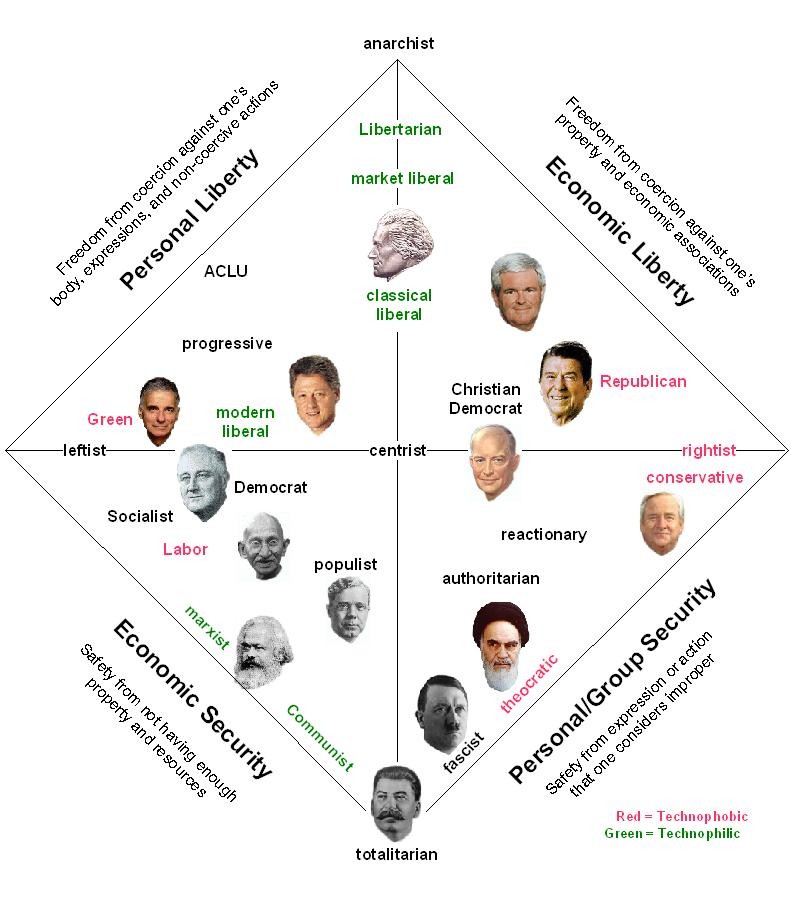
In theory this third dimension is independent of the first two, but in practice it correlates (imperfectly) with the personal liberty vs. security axis. The two sorts of enfranchisement for which the correlation is weakest are fetal status (see Pro-Choice) and citizenship. Favoring enfranchisement of non-citizens implies support for free trade, liberal immigration, foreign aid, human rights abroad, and humanitarian interventionism (as opposed to isolationism or imperialism). Foreign intervention has historically been imperialist rather than humanitarian, and so doves have usually been progressives, and hawks have usually been reactionaries.
Misunderstandings"Pro-Choice". Many otherwise progressive thinkers subordinate any consideration of a fetuses' franchise to the liberty of women to control what happens inside their skin. These self-styled progressives would never subordinate a slave's (or trespasser's) franchise to the liberty of plantation owners to control what happens inside their fence lines. The inconsistency seems more of an emotional over-reaction to the recent non-enfranchisement of women at the hands of men, and less of a clear-eyed decision to draw the line of franchise at e.g. birth or fetal viability. Such a naked assertion of women's entrenched interest over that of fetuses, without due consideration and explicit rejection of fetal franchise, is hardly progressive but rather plainly reactionary.
Thus being "pro-choice" on abortion is as disingenuous as being "pro-choice" on slave-owning. The position actually being advocated is the non-personhood of fetuses and slaves, respectively. But "No personhood for fetuses" is not a very fun bumper sticker, and so opponents of fetal personhood choose to obscure the real issue.
| Location | Regime | Deaths | Era |
| Soviet Union | Communists | 61,900,000 | 1917-1990 |
| China | Communists | 35,200,000 | 1949-1994 |
| Germany | Nazi Third Reich | 20,900,000 | 1933-1945 |
| China | Kuomintang | 10,400,000 | 1928-1949 |
| Japan | Imperial-Fascist | 6,000,000 | 1936-1945 |
| China | Communist Guerrillas | 3,500,000 | 1923-1948 |
| Cambodia | Communists | 2,000,000 | 1975-1979 |
| Turkey | "Young Turks" | 1,900,000 | 1909-1917 |
| Vietnam | Communists | 1,700,000 | 1945-1994 |
| North Korea | Communists | 1,700,000 | 1948-1994 |
| Poland | Communists | 1,600,000 | 1945-1948 |
| Pakistan | Yahya Khan | 1,500,000 | 1971 |
| Mexico | Porfiriato | 1,400,000 | 1900-1920 |
| Yugoslavia | Communists | 1,100,000 | 1944-1990 |
| Russia | Czarist | 1,100,000 | 1900-1917 |
| Turkey | Mustafa Kemal "Ataturk" | 900,000 | 1918-1923 |
| United Kingdom | Constitutional | 800,000 | 1900-1994 |
| Portugal | Fascist | 700,000 | 1926-1975 |
| Croatia | Fascists | 700,000 | 1941-1945 |
| Indonesia | Suharto | 600,000 | 1965-1994 |
American Political PartiesThe Democratic Party is the populist American political party which was founded in 1792 by Thomas Jefferson, which supported state's slavery rights before the Civil War, and which was refocused by Franklin Roosevelt toward leftist policies of welfare statism, civil rights and economic equality. As leftists, Democrats are more likely to favor economic security over economic liberty, but personal liberty over personal security. Democrats are more likely to prefer centralized federal solutions over local, private or market solutions. Democrats are less likely to trust free markets to be efficient and fair, and thus are less likely to trust individuals with economic freedom. Late 20th-century Democrat constituencies include blacks, Jews, organized labor, hispanics, the poor, gays, urbanites, and women. Late 20th-century Democrat policies are as follows.
Groups in all capitals are ethnogeographic and not linguistic.
AFRICAN
  Niger-Congo
    Bantu
      Xhosa
      Swahili                   Tanzania
      Shona                     Zimbabwe
      Zulu                      S. Africa
      Xhosa                 7M  S. Africa
      ..
    ..
  Nilo-Saharan
  Khoisan                       Namibia: "Bushmen", "Hottentots"
    Hadza, Sandawe              Tanzania!
    ..
SOUTHEAST ASIAN
  Sino-Tibetan
    Sinitic
    Tibeto-Burman
  Austric
    Austronesian
    Tai-Kadai                 Thai, Lao
    Hmong-Mien
    Austroasiatic

      Munda                   NE India
      Mon-Khmer               Vietnamese
  Indo-Pacific
    Melanesian
    New Guinean
  Aboriginal
NORTH EURASIAN
  Basque
  Nostratic
    Afro-Asiatic
      Semitic
        Hebrew
        Arabic
      Cushitic
      Berber
      Chadic
    Kartvelian
    Dravidian
    Eurasiatic
      Altaic
        Turkic
          Turkish
          Uzbek
          Kazakh

          Turkmenian
          Azerbaijani
          ..
        Mongolic
        Tungusic
          Manchu ..
        Korean
        Japanese
      Uralic
        Finno-Urgic
        Samoyedic
        Yukaghir
      Indo-European
        Celtic
          Brythonic
            Breton
            Cornish
            Welsh
          Gaelic
            Irish
            Scots
            Manx
        Italic
          Latin
          Italian
          Spanish
          Portugese
          French
          Provencal
          Romanian
          Rhaeto-Romance
        Greek
        Germanic
          West
            English
            Frisian
            German
            Dutch
            Afrikaans
            Yiddish
          North
            Danish
            Norwegian
            Swedish
            Icelandic
            Faroese
        Balto-Slavic
          Baltic
            Lithuanian
            Latvian
          Slavic
            West
              Polish
              Czech
              Slovak
              Sorbian
            South
              Bulgarian
              Macedonian
              Serbian/Croatian
              Slovenian
            East
              Russian
              Belarusian
              Ukrainian
        Armenian
        Albanian
        Tocharian
        Anatolian
        Indo-Iranian
          Indic
            Sanskrit
            Hindi, Urdu
            Sinhalese
            Nepali
            Bihari
            Bengali
            Romany
          Iranian
            Persian
            Kurdish
            Pashto
            Ossetic
            Baluchi
            Tajik
AMERICAN
  Eskimo-aleut
  Na-Dene
  Aztec-Tanoan
  Mayan
  Carib
  ...
The following history of humanity will supplement traditional political history (who did what) with technological, intellectual, economic, and military history (how and why things were done).
Modern humans spread rapidly from their origins in E. Africa and SW Asia. H. sapiens sapiens arrived in Europe 40 Kya, and by 30 Kya H. neanderthalensis was extinct. Modern humans reached Australia from 60 to 40 Kya, and apparently caused the extinction of much megafauna there, such as the rhino-sized marsupial herbivore Diprotodon. Humans spread into Siberia by 20 Kya and crossed the Bering land bridge into the Americas by 15 Kya. As in Australia, megafauna that had not coevolved with hominids soon became extinct when humans arrived.
European humans retreated to southern European refugia during the last glacial maximum (Wurm IV) around 17 Kya. The end of the last ice age led to a recolonization of Europe around 13 Kya.
Farmers (or at least farming) from SW Asia spread into Europe around 8.5 Kya.
| Advance | When | Who |
|---|---|---|
| Stone Tools | 2.5 Mya | |
| Fire Control | 1.4 Mya | |
| Language | 100-50 Kya | |
| Watercraft | 40 Kya | SE Asia 13 Kya: Mediterranean |
| Food Production | 10.5 Kya | |
| Metallurgy | 4000 BCE | Eurasia/China 1500: Andes |
| Horse Riding | 4000 BCE | Central Asia |
| Writing | 3500 BCE | Egypt; Mesopotamia; China; 500 BCE: Maya |
| Philosophy | 600-335 BCE | Thales et al; Aristotle |
| Mathematics | 550-200 BCE | Pythagoras; Euclid; Archimedes; Apollonius |
| Firearms | 1300s | Europe (gunpowder: China 800s) |
| Movable Type | 1454 | Gutenburg; 1040: Pi Sheng; 1300s: Korea |
| Heliocentrism | 1543 | Copernicus; c250 BCE: Aristarchus |
| Telescopy, Microscopy | 1608 | Lippershey, Galileo |
| Calculus | 1666 | Newton, Leibniz |
| Mechanics | 1687 | Newton |
| Heat Engine | 1712;1769 | Newcomen; Watt |
| Electromagnetics | 1831;1864 | Faraday; Maxwell |
| Wire Telecom | 1844 | Morse; 1876: Bell |
| Evolution | 1859 | Darwin, Wallace |
| Germ Theory | 1862 | Pasteur |
| Genetics | 1866 | Mended; 1953: Watts, Crick |
| Set Theory | 1874 | Cantor; 1902: Russell |
| Radio Telecom | 1895;1904 | Marconi; Fleming |
| Powered flight | 1903 | Wright |
| Special Relativity | 1905 | Einstein |
| General Relativity | 1916 | Einstein |
| Quantum Theory | 1927 | Heisenberg; 1900: Planck; 1928: Dirac |
| Space flight | 1929 | Tsiolkovsky; 1957: Sputnik |
| Big Bang | 1929 | Hubble; 1948: Gamow et al. 1965: Penzias, Wilson |
| Incompleteness | 1931 | Godel; 1937: Turing |
| Fission | 1938 | Hahn; Oppenheimer |
| Computing | 1946;1948 | Von Neumann; Bardeen et al |
| Packet Networking | 1961 | Baran, Davies |
| Standard Model | 1974 | 1964: Gell-Mann; 1967: Weinberg, Glashow, Salam |
| (?) String/M Theory | 1984 | Green, Schwartz |
Several important advances are nonetheless either derivative or not quite revolutionary.
Future HistoryHumanity will enjoy increasing political and economic liberty, as well as increasing freedom from ignorance and superstition. Humanity will enjoy increasing prosperity and steady progress within the limits defined by the laws of physics. Effective immortality may result from technology allowing avhuman mind to sustain its brain or perhaps transform itself into an intelligent artifact. Human civilization will experience neither salvation nor extermination by nature, machines, aliens, or gods. Humanity will spread throughout the Solar System and into the Milky Way, and be enriched by contact with other intelligent species and artifacts. Eventually humanity's descendants will so improve their genes and minds that Homo sapiens will exist primarily as a revered memory.
Technological RevolutionsThe long-term history and fate of humanity is driven almost entirely by technology. There have been five great technological revolutions in hominid history, and one or two others are faintly visible on the horizon.
Tools. The penultimate great biological advance on Earth was the evolution of hominid intelligence. This led directly to the hominids' first great technological revolution at the beginning of the Paleolithic Age by 2 Mya: the use of stone tools and (later) fire. Tools and fire granted to hominids a mastery over predators, prey, and the elements that was literally unimaginable to other primates.
Language. The second technological revolution was also the most recent great biological advance on Earth: the development of language by 50 Kya. The development of language, watercraft, and weaving combined to allow early modern humans from Africa and SW Asia to master climates and locales throughout the world.
Agriculture. The third revolution was the development of agriculture at the beginning of the Neolithic Age about 10 Kya. The resulting specialization led to the advanced development of writing, government, and science.
Industry. The fourth revolution was the Industrial Revolution that was under way by 1840. It included the development of heat engines, medicine, electromagnetics, and (later) atomics. The Industrial Revolution was of course only possible because the Scientific Revolution that began during the Renaissance. However, it was not until the Industrial Revolution that living standards finally made a leap to levels that would have been unimaginable to Aristotle or even Newton.
Information. The fifth revolution is the current Information Revolution. It had started by 1971 with the development of electronics, computing, and networking, which together had major impacts on commerce and communications by the 1980s and 1990s. The Information Revolution will continue with the nascent developments of photonics and genetics. It will largely complete the liberation of humanity from tyranny and superstition. It will witness the completion of humanity's basic understanding of the origin, mechanism, and fate of mind, life, and the universe itself.
Generation. By about 2200 a sixth revolution will be under way, driven by some combination of:
Homogenetics. By about 3000, modifications to the human genome will no longer be confined to changing the frequency or expression of existing genes, but will include the design of new genes. This will ultimately transform humanity into a new and improved species.
Automentation. After engineering the human genome, the next (and perhaps last) technological revolution will be to engineer the (human?) mind. The first step will be the creation of neurological interfaces between human brains and computing devices. Another step might be the (perhaps neuron-by-neuron) replacement of some brain components with improved artificial parts. Or, it may be possible for a person to gradually offload mental processing from her brain to her computational prostheses. Perhaps eventually she could dispense with her fragile mortal brain altogether, so as to gain immortality while still preserving personal identity.
MisunderstandingsEstimating Progress. The modern idea of Progress arose in the Enlightenment. In the subsequent few centuries, prognosticators almost always underestimated future progress. Only towards the end of the miraculous period of advances from 1859 to 1945 did futurologists consistently start overestimating future progress.
The Doomsday Argument is the thesis that the future of humanity may be relatively short because a human randomly sampled from all humans who ever will have lived is more likely to be middling in birth rank than early. In the absence of other information about humanity's prospects, the Doomsday Argument would be significant. In the presence of almost any such information, the Doomsday Argument is irrelevant.
Paranormality. The paranormal phenomena alleged in 2000 by many humans will never prove to be real and will over time be recognized as delusions, hysteria, myths, nonsense, and hoaxes.
Reanimation. There will never be any reanimation of humans whose brains have suffered any of the degradation that occurs at normal temperatures when metabolism ceases. Human personalities may someday be crudely simulated, but such simulations will never have significant fidelity and would not in any event have the identity of the simulated personality.
Explanation of Somethingness. Humans will never have a definitive answer to the question of why there is something rather than nothing. Humans may, however, eventually be able to show that no definitive explanation of existence is possible.
Superluminal Communication. There will never be a way to travel or communicate through space at speeds greater than that of light. Nor will there be a way to warp spacetime to circumvent this restriction.
Temporal Travel. There will never be a way to travel or communicate backwards in time. While time travel is not explicitly impossible under the known laws of physics, the proposed wormhole mechanism for it would require energies and technologies that are simply not achievable. Note also that a wormhole time machine would not allow travel back to before the wormhole was created.
Teleporter Travel. There will never be a way for humans to travel via transmission of information describing their physical constitution. Quantum considerations almost certainly preclude the extraction of a sufficiently detailed description, and such a discontinuous process would not preserve personal identity. The only possible way would be a gradual and continuous disassembly and reassembly with an ongoing causal link between the two separated halves.
Uploading. Like teleportation, transferal of a human mind from a brain to an artifact is almost certainly impossible and would nevertheless not preserve personal identity. Were either technology possible, then a minor improvement would be a non-destructive version that preserves the original body and brain, thus revealing the technology to be a duplicator rather than a teleporter or uploader. The possible technology closest to uploading would be a (relatively) gradual and continuous transformation of the functioning human brain into another substrate.
Energy and Momentum Non-Conservation. There will never be a way to increase the available energy or change the net momentum in a closed system.
Super-Intelligence. Cognitive ability can increase quantitatively in efficiency, flexibility, speed, capacity, bandwidth, and network associativity, but not qualitatively in its kind of reasoning or knowing. There are no forms of reasoning or kinds of knowledge that are in principle inaccessible to regular intelligence.
Human Evolution. Humanity is very unlikely to undergo significant further natural evolution. Since the beginning of the Neolithic Age, the development of humanity has been influenced much more by changes in culture than changes in genes. This will continue indefinitely, even considering genetic engineering.
Singularity. The Singularity is what Vernor Vinge describes as a moment in the future when the ongoing exponential increases in technological capability culminate in a discontinuity beyond which predictions based on continuous extrapolations do not apply. One candidate for the Singularity is when humanity improves artificial intelligence to the point that it is better than humans at improving artificial intelligence. Another candidate is when the world's computers are networked into a single self-conscious mind. A third is when runaway productivity is achieved through artifactual life or nanotechnology, perhaps provided by extraterrestrial intelligence.
The Singularity will not happen. First, the limits to intelligence apply to artificial intelligence as much as to natural. Second, intelligence is likely not to vary qualitatively as a function of things like processing speed or memory that are increasing exponentially. Third, the effort to make minds faster or smarter will quite likely be subject to diminishing returns. Fourth, artificial minds will at first not be designed but rather grown and evolved, and will be subject to most of the same limits as minds that are naturally grown and evolved.
Antigravity. There will never be a way to repel matter by virtue of its mass, or even to just shield the attractive gravitational force of mass. Nor will there be an inertial drive -- a way to accelerate an object uniformly, as in a gravitational field.
Vacuum or Zero-Point Energy. It is unlikely that humans will ever be able to extract useful amounts of energy from the vacuum or zero point.
PhilosophyLoss of faith. By explaining the overwhelming majority of apparent Design in the universe, Darwin's theory of evolution made faith in a "God of the gaps" essentially indefensible among intellectuals. As modern physics eliminates the last traces of apparent Design in the universe, intellectual fideists have in the 20th century retreated from actual revelation-based faith. They are seeking refuge in either outright mysticism or a false skepticism that pretends deism is a skeptical epistemologyinstead of a supernaturalist metaphysics. Rank-and-file fideists are responding variously with fundamentalism, mysticism, and (primarily) an operational agnosticism that maintains only the trappings of faith. This hollow fideism will dilute into vague agnostic mysticism by about 2150, while hardcore fideists will dwindle and become increasingly isolated.
Decline of mysticism. While faith will continue to dwindle sharply, mysticism will continue to absorb an infusion of former fideists as they confront Darwinism and are exposed to Eastern mystical traditions. Mysticism will thereafter decline asymptotically to a core minority devoted to altered mental states and ecological primitivism.
Spread of skepticism. The revolutions in biology and physics from 1859 to 1929, and the subsequent technological improvements in telecommunications and productivity, will continue to fuel the spread of humanist skepticism. In developed societies like America, belief in revelation will dwindle as rapidly as did (for example) belief in the subhmanity of Negroids. The decline of revelation-based faith will be somewhat disguised by its transformation into a bland mystical reverence for the alleged intention of revelation, but the loss of dogmatic faith will be apparent to those who bother noticing it. Key indicators will be the decreasing number of humans who believe that their mind -- including memories, consciousness, and personality -- will survive death, or who have serious beliefs in the paranormal.
Consolidation of philosophy. Continental philosophy will continue to thrive for at least a century, especially among humans who misunderstand or fear the recent progress in science, technology, and sociopolitics (viz., the ascendancy of free-market capitalism). Positivism will be the tacit or explicit belief of those leading this ongoing progress. Positivist epistemology and extropian ethics will in the Third Millennium displace first Continental philosophy and eventually most competing forms of mysticism and faith. This will complete the move toward skeptical empiricism that began in the Renaissance. Most fundamental philosophical issues will thenceforth be considered settled, similar to how Realism and Substance Dualism are no longer serious philosophical positions. These developments have some chance of being altered by two technological advances: artificial intelligence, and communication with extraterrestrial intelligence. While extropian ethics is unlikely to be affected, either advance could offer compelling contributions to epistemology or even metaphysics. The most likely contributions would be toward clarification and formalization, and not towards radically alternative philosophical positions.
MathematicsThere is little prospect of fundamental advances in mathematics similar to those that happened during the Machine Age. Future progress in mathematics will consist primarily in formalization and in proofs such as:
Physical ScienceFate of the universe. In the first few decades after 2000, humans will learn the fate of the universe: collapse, infinite expansion, or asymptotic expansion. Observations in 2000 indicate infinite expansion, but theoretical elegance argues for asymptotic expansion.
Origin of the universe. In the first few decades after 2000, humans will create a quantum theory of gravity that will unify it with the other physical forces. By roughly 2100, humans will learn almost all they will ever know about how the laws of physics are constrained to be the way they are, how they allowed for the Big Bang to happen, and how many physical free variables there are.
BiologyGenomics. Molecular biologists will continue for many centuries to sequence the genomes of entire species and the genotypes of individual humans. This will allow an inexorably increasing understanding of the evolutionary ancestry of earth's taxa, and of the genealogy of earth's humans. Genomics and electronic genealogy will combine to create a worldwide genealogical network that will include almost all humans born in literate societies after 1900 or even earlier.
Genesis. By about 2050, molecular biologists will be able to describe in increasing detail how life based on ribonucleic and amino acids arose on Earth four billion years ago as a result of auto-catalytic chemical processes of increasing complexity. Biologists will also be able to estimate how probable or improbable the development of life was.
Paleontology. Over the first century or two after 2000, biologists will greatly increase human understanding of how and why life evolved as it did over the last few billion years. In particular, anthropology will reach a general but not detailed understanding of how and why intelligence developed in hominids.
Exobiology. It is likely that by about 2100, humans will discover
Biochemistry. Humans will in the 2000's slowly reverse-engineer the genomes of H. sapiens and other important terrestrial species, allowing increasingly radical genetic engineering.
Neuropsychology. Humans will in the 2000's gradually unravel the details of how the neural processes of the human brain create mental phenomena like consciousness, cognition, perception, affect, and volition.
Social ScienceEconomics. Economic theory and practice will be refined as information technology allows the ever-improving collection and processing of economic data. However, information technology and central planning are unlikely to ever run humanity's economy as efficiently as the distributed processes of a free-market economy.
Sociology and Political Science. Humans will grow increasingly convinced that libertarian capitalism under federal republican democracy is the sociopolitical system that best provides for human justice and prosperity.
Psychology. Cognitivism will continue to be the most successful school of psychology, and Freudianism will be more and more widely discredited. Human efforts to communicate with cetaceans and with other primates will be tightly constrained by the limited cognitive and linguistic ability of these animals.
Linguistics. Aided in part by human genomics, linguists will make some more progress in tracing the family tree of human languages, but will never know many details about how the first human languages arose and what they were like.
History. Fluctuations of theme and emphasis in the interpretation of history will continue but will ultimately dampen out. There will not be a theory of history that can reliably predict the future or deterministically explain the past.
SpaceExploration. Humans will continue robotic exploration of the solar system, including sample return missions by 2020. Humans will establish by 2100 an unmanned radio observatory on the far side of the moon, which is the most radio-quiet place in the solar system. Humans will by 2200 launch robotic telescopes to use the Sun's gravitational lensing out at the edge of the solar system. Humans will by 2300 start sending primitive Von Neumann probes to explore the galaxy and radio their findings back to earth. By about 3000 humans will begin receiving telemetry from high-speed flybys of nearby star systems.
Stations. Humans will by 2200 establish permanent manned stations in Earth orbit and perhaps on the moon, primarily for microgravity and spacecraft manufacturing. Extraterrestrial mining and mass production for terrestrial use is unlikely ever to be competitive with terrestrial processes. Extraterrestrial energy collection or generation is likely not to be competitive with terrestrial processes until well after Earth has too much heat pollution to be able to use the extra energy.
Colonization. There are several reasons humans will want to establish ecologically self-sufficient colonies beyond Earth:
If attempted at all, the terraforming of Mars, Venus, or a moon of Jupiter or Saturn would likely not begin for several thousand years and might take thousands of years more to complete.
QuantaPhotonics, optics, and computational processing of spread-spectrum radio will lead to an enormous increase in bandwidth by 2020.
MoleculesNanotechnologyis the creation and use of materials and devices constructed by arranging individual atoms and molecules. Nanotechnology will be used to create extraordinarily strong or light materials and extraordinarily tiny and versatile machines. Self-reproducing nanotech "assemblers" may not be feasible for several centuries, and will not be as versatile as some would hope. The lesson of software is that even when manufacturing costs fall to zero, design and development usually remains a unique problem for each application of the technology.
LifeGenetic Engineering. Humans will over the next few centuries use genetic engineering to change natural organisms into increasingly useful forms. However, it will require centuries more before humans fully understand the biochemistry of even the simplest natural living system. After a millennium or so, humans will be able to design new ribonucleic organisms. After perhaps another millennium, humans will be able to design organisms with non-ribonucleic biochemistry.
Artifactual Life is life created by intelligence and not based on natural life. Humans will in about two centuries be able to create artificial systems that can reproduce themselves. After another century or so, humans will be able to create Von Neumann probes. A Von Neumann probe is a device designed to travel to another star system and reproduce itself there.
InformationComputing. After 2050 the primary constraints on human computing technology will not be processing speed or communications bandwidth or memory capacity and density, but rather physical limits of
BrainNeuropsychology will allow the creation of neural interfaces and prosthetics for sensing, computing and communicating. However, mind-reading technology will not improve much beyond current polygraphs, except perhaps through invasive nanotechnology that would probably require extensive adaptation to individual brains.
MindArtificial Intelligence is intelligence created by intelligence and not based on natural intelligence. Humans will develop AI in about two hundred years. However, these systems will initially not be designed or engineered but rather grown or raised, much as natural human intelligences are. Another millennium may be required before humans understand the inner workings of intelligence enough to modify or augment it.
Automentation. Will humans find a way to transform their natural brains into artificial ones that are easier to maintain and augment? Such techniques might depend on molecular biology and neuropsychology as much as on nanotechnology and information processing.
Exopsychology. When (and if) humans detect extraterrestrial intelligence (ETI), several possibilities for communication will exist.
1-way transmission. If ETI is detected through electromagnetic emissions over interstellar distances that are not intended to communicate with emerging civilizations such as earth's, then humanity will have to introduce itself. The important issues will be what to tell and what to ask. Humanity should tell ETI a summary of its knowledge of itself and the universe, perhaps by sending information similar to that in this text. (The summary would have to be made intelligible to ETI, perhaps by including a multimedia dictionary and grammar of the relevant human language.) Humanity should ask ETI for a summary of the ETI's knowledge, including available answers for humanity's major unanswered questions and technological assistance in areas like communication, information processing, energy, transportation, and materials.
1-way reception. If ETI is detected through electromagnetic signals over interstellar distances that are intended to communicate with emerging civilizations, then there is a wide range of possible messages the signals could encode. ETI might be broadcasting merely its existence, telling nothing more than the sort of rudimentary information that humanity included in its own 1974 Arecibo transmission. Another extreme possibility is that a federation of ETIs might be broadcasting a continuously-updated "Encyclopedia Galactica" summarizing all their knowledge. Any such message would be designed to be readily intelligible at least at a superficial level, while advanced and detailed understanding might overtax humanity's current linguistic or technological competence.
2-way communication. The third possibility is for 2-way communication, for which interactive latency is the critical variable. Interstellar communication would have a latency of at least decades or centuries, while communication with an ETI presence inside the solar system would have a latency of at most a few hours. Interstellar 2-way communication would merely be a series of 1-way transmissions and receptions. By contrast, intrastellar communication could permit the exchange of time-critical information or even material goods. ETI could greatly accelerate advances in
Food ProductionGenetic engineering will continue to improve crop yields and hardiness. By 2050 the price of fresh water will hit a permanent ceiling determined not by its natural supply but by the energy cost of its desalinization and transportation. By about 4000, humans will use genetic engineering to culture animal tissue in bulk instead of raising animals en masse. By about 5000, humans will have geno-industrial techniques for efficiently mass-producing food consisting of only of essential nutrients (glucose, amino acids, vitamins, minerals, and lipids) and made delectable by artificial flavors or direct neurological stimuli. Human population on earth will ultimately be limited not by food production but by heat pollution.
ShelteringOver the next century or so, cities will be transformed from centers of industry and work to centers of culture and entertainment. Telecommuting will blur the distinction between home and office, and will allow humans to locate their homes by climate, culture, and time zone rather than by proximity to industry. Undersea or aerial dwellings are not likely to ever be built in significant numbers. Floating communities and estates will by 3000 become increasingly popular among humans unable to afford scarce land property in desirable climates or in both hemispheres. Human population on earth will ultimately be limited not by living space but by heat pollution. Only when heat pollution becomes a serious problem on Earth will humans start building significant populations beyond Earth.
CommunicationNetworking. Packet-switched networks like the Internet and its successors will be the primary technology humans use for remote and mass communication for at least several thousand years, and perhaps indefinitely. Communication costs will become independent of distance. Bandwidth will be limited only by the deployment of fiber optic lines and wireless local loops. Almost every device with any internal information state or human interface will have (usually wireless) connectivity to the global network. Multi-party telepresence will allow routine arbitrary amounts of social interaction among even distant family and friends. Public-key cryptography will always allow secure and private communication even if network traffic can be intercepted. Networking of ubiquitous stereo and spherically immersive audio-video sensors will combine with satellite and topographic data to allow real-time telepresence at, or virtual travel to, almost any interesting place on Earth. Archival storage of such sensor data will allow a sort of read-only time-travel into the past.
Storage. Storage and recording technologies will increase in capacity, speed, and affordability, such that the major cost associated with storage will be the intelligent effort required to organize or digest it. Humans will by 2100 be able to digitally record, archive, and transcribe as much as they want of what they see, hear, and say over their entire lifetimes. An ever-increasing majority of existing text, audio, video, and images will be digitally archived into what will be in effect a library of humanity searchable from anywhere on the global network. Existing automated translation technology will make archived texts available in any major human language. Real-time voice recognition will by 2010 be combined with automatic translation and speech generation to produce a crude but effective "universal translator" that will allow a monolingual human to converse (at least slowly and simply) with any speaker of any major human language.
EntertainmentMedia. The digitization of music will be followed by the digitization of television, movies, books, and periodicals by 2020. This trend will lead to the routine unauthorized reproduction and distribution of copyrighted text, images, audio, and video. Executable and perishable data are the only data types exempt from this problem: software can decline to function if not licensed, and live data can be hard to reproduce and distribute quickly enough. (Databases can also be exempt, if their owners do not release entire copies and can prevent exhaustive enumeration of the entries.) Only extreme state action could minimize such unauthorized copying, by banning certain copying technologies.
Pre-recorded television programming will by 2030 no longer be mainly viewed on broadcast channels carrying occasional commercials. Such viewing will first move to time-shifted commercial-skipping recording and then to on-demand downloading financed by integrated banner and product placement advertising as well as by voluntary micropayment tips. Even live programming (e.g. sports and news) will have difficulty making viewers sit through commercial breaks. Photorealistic computer-generated imagery will by 2020 replace physical actors, sets, and locations for many video applications, but actors will still be used as input models.
Recreation. Tourism will expand to eventually include currently inaccessible places like the North and South Poles, the summit of Everest, seabottom shipwrecks, and even Tranquility Base on the moon. Virtual visual and auditory reality will by 2020 be the preferred way to play computer games. Humans will continue to play and spectate at sports, while outdoor and wilderness recreation will increase in popularity. Dogs and cats will continue to be humans' favorite pets, but by 2300 they will be genetically improved (e.g. not to shed) and will have competition from pseudo-intelligent robotic "stuffed animals".
Vice. Electronic gambling and pornography will become available to any adult who wants them, and adult access to prostitution will continue to expand. Most psychotropics will be legalized by 2150, especially as neurochemistry becomes more able to manage the problems of addiction and withdrawal.
TransportationTransportation technology is mainly a function of the cost, size, and weight of energy storage and conversion technology. As artifacts become smaller and lighter and as humans become wealthier and more geographically dispersed, transportation will increasingly become focused on moving humans and the water they need.
Neighborhood. For distances of up to about ten kilometers, humans will increasingly be using battery-powered conveyances such as ultracompact cars, bicycles, and scootboards. Human bodily flight will by 2040 have overcome problems of safety and energy cost, but nuisance due to noise and wash will limit its use in urban areas. Nanotechnology could in theory allow for lighter-than-air bodily flight if it could just construct a lightweight vacuum sphere 5 meters in diameter.
Regional. For distances of up to several hundred kilometers, humans will continue to use cars and their successors indefinitely. In densely populated areas, conventional buses and trains will maintain their popularity, until the autodrive revolution in around 2060. Automated vehicular and traffic control will merge the best properties of road and rail, creating a unified system of roads with rail-like traffic flows. By 2080 VTOL aircraft will be sufficiently cheap, safe, and easy to control that they will be as widely owned as recreational vehicles are in 2000. However, nuisance issues will restrict where they can land and takeoff, and safety will require that they fly under at least semi-automated traffic control in busy flight corridors.
Continental. Air travel will continue to get cheaper and more efficient in the first decades after 2000. By 2030 humans will apply supersonic and perhaps hypersonic travel to a few more commercial intercontinental routes. Air traffic congestion around busy metropolitan areas will be partly abated by automated traffic control but may ultimately require shifting some of the passenger load to long-range high-speed subsonic trains. Ships will continue to handle bulk transport without major changes such as heavy use of of hydrofoils or hovercraft.
Space. Space propulsion will eventually transition from chemical and ion to fusion and eventually antimatter.
EnergySources. Fossil fuels will continue to provide the bulk of humanity's power through at least 2150. Solar energy will continue to provide humanity's food (through photosynthesis) as well as a limited part of its power (through water and small amounts of wind, wave, and photovoltaics). Geothermal and fission energy will not supply major parts of humanity's power, but by 2150 thermonuclear fusion will.
Applications. Plugged devices will continue indefinitely to be powered by electricity delivered as alternating current over a power grid that may eventually start taking advantage of superconductivity. Unplugged devices will continue to be powered by chemical batteries that will be the limiting technology for more and more applications. Heating devices will continue to be powered by a combination of fossil fuels and electricity. Internal combustion in vehicles will be supplemented by batteries and flywheels before being replaced by hydrogen fuel cells around 2075. Energy storage through anti-matter containment will by 2300 be feasible for space propulsion and military explosives. Safe and efficient anti-matter batteries would be as revolutionary as chemical batteries have been, but may not be practical before 2500.
GovernmentCommunication technology and free market practice will continue to make government more open and more subject to competitive pressure. Electoral procedures will be modernized towards preference ballots, in which voters rank candidates and in successive rounds of ballot-counting the weakest candidate's votes are redistributed until a candidate achieves a majority. Government will increasingly use market-based mechanisms such as vouchers, negative taxes, or outright privitization. Communications technology will promote less corrupt and more open practices in both politics and government.
MilitaryStrategic warfare. Ballistic and cruise missiles will continue to be easier and cheaper to attack with than to defend against. Thus nuclear missiles will continue indefinitely to be humanity's premier technology for strategic warfare. (Other technologies of mass destruction are more suited to unconventional warfare.) Nuclear weaponry may ultimately be replaced by antimatter warheads only if antimatter generation and containment technology becomes effective.
Conventional warfare. Fear of nuclear warfare will continue to make conventional warfare an important capability. As it has since Pearl Harbor, conventional warfare will continue to be dominated by the ability of air power to find and strike surface targets (and also to move and supply ground forces). For reasons of miniaturization, agility, and pilot risk, combat aircraft will by 2060 tend to be remotely piloted (unless transmission of aircraft sensor data makes those aircraft much easier to target). Against opponents without competitive submarine power, sea warfare will continue to be dominated by aircraft carriers. Unless boutique anti-submarine and anti-missile technology can stay ahead of budget submarine and missile technology, aircraft carriers will by 2100 be replaced by submarines carrying aerial weapons systems. Land warfare will continue to be dominated by sensor and guidance technology, especially as all battlefield sensing and intelligence becomes integrated and distributed. Although camouflage, first sight, and first shot will increase in tactical importance, the hard-to-hide and easy-to-hit main battle tank will nevertheless enjoy at least several more decades of battlefield preeminence, thanks to its superior mobility and fire control. Orbital platforms will become increasingly important for communications and surveillance, even as they become more vulnerable to anti-satellite weaponry. This vulnerability will be offset somewhat by the stealthiness and redundancy enabled by miniaturization and lower launching costs.
Unconventional warfare. Fortunately, guerrilla and terrorist warfare will in the long run diminish as more and more of humanity enjoys liberty and prosperity. Unfortunately, the weapons available to terrorists will become more and more destructive. Terrorists will increasingly make use of chemical weapons, and will also attempt to create man-made catastrophes. Except possibly for denial-of-service attacks, "information warfare" will by 2020 be useful only against primitive systems that haven't yet taken advantage of modern security techniques.
Ultimate warfare. At the limit, military technology will plateau at two abilities: to gather and use information about enemy plans and actions, and to collect and deploy energy used to disrupt and destroy the enemy's war-making capability. By 2300 humanity will have mastered the fundamentals of nanotechnology and energy storage using anti-matter. At that time, even the most advanced alien aggressor might not really have a qualitative advantage in fundamental technology, but rather a (potentially overwhelming) quantitative advantage in its ability to deploy sensors, warheads, and nanobots. "Information warfare" will not be a significant weapon between separate and hostile civilizations, as information is too easy to secure when there is zero desire for communication and cooperation.
EducationTeaching. Communication and information technology will supplement human teachers and make them more productive, but they will remain essential for educating children. Technology, the shortening workweek, and public policy innovation will make home schooling more common. As information resources grow in richness and as technology makes careers more dynamic, undergraduate education will increasingly focus on learning to learn. Undergraduate and continuing education will be transformed significantly by technology, but graduate research will continue to be like apprenticeship.
Knowing. Technology change and information growth will make meta-knowledge increasingly important: knowing what to know, knowing what one does and does not know, knowing what one can and cannot know, knowing how to find and evaluate knowledge, and knowing how to express, store, and classify knowledge. Meta-knowledge will allow humans to take increasing advantage of information and communication devices and prostheses. However, direct downloading of knowledge will remain almost impossible without a detailed and thorough understanding of mental architecture that is likely to differ subtly but significantly from person to person.
Health CareDelivery. Telemedicine will become more common, but health care delivery will continue to be provided mainly by physicians working in clinics and hospitals.
Diseases. The incidence of genetic diseases will slowly but steadily be minimized in the next few centuries by genetic screening and engineering. Treatments for the major infectious, immunological and cancerous diseases will be developed through several more centuries of continued research. Curing the major neurological and aging-related diseases will take much of the coming millennium. Obesity and other nutritional diseases will be cured in the next two centuries by advances in pharmacology and in artificial foods. More and more forms of injury will be made non-lethal through surgery and repairable through transplants and prosthetics.
Longevity. Humans will increase their longevity by finding ways to preserve the body, the brain, and the mind. Expected and maximum human longevity will increase by at least thirty years by 2100. Will humans find a way to keep the body or at least the brain alive indefinitely?
ManufacturingRobotics will continuously increase in importance in manufacturing. Automation will make hardware design and manufacturing increasingly like software design and manufacturing. That is, absolute manufacturing costs will continuously drop, but design and development will remain relatively costly even while becoming absolutely more productive. Ultimately, the cost of material goods will be the amortized cost of specifying and designing them plus only the marginal energy required to manufacture and deliver them.
MerchandisingDisintermediation is the removal of intermediaries (such as retailers, sales agents, and brokers) from transactions between suppliers and consumers armed with information to which formerly only the intermediary had access. Disintermediation driven by information and communication technology will continue to make transactions cheaper and markets more efficient and pricing more competitive. Intermediaries will continue to disappear in markets where they enjoyed quasi-exclusive access to information (initially travel, auto retail) or where they retail fungible items that can be well-described through telepresence (initially books, music, electronics). Fixed pricing will increasingly give way to auctions and reverse auctions. Suppliers will continue to cut design and inventory costs by allowing consumers to directly specify what they want produced by the suppliers' automated plants.
BrokeringDisintermediation will continue to revolutionize or obsolete conventional practice in most brokerage markets. However, the markets themselves for money, equity, commodities, risk (insurance), and space (real estate) will operate indefinitely, joined by markets for natural-resource consumption and pollution.
ServicesMost service occupations that can be automated without artificial intelligence or mobile robotics have already been automated. Exceptions are some service occupations in industries like transportation and media, which will be automated in the coming decades using sophisticated (but not truly intelligent) information processing technology.
Economic DevelopmentsHuman standards of living will continue to rise indefinitely because human productivity will continue to rise indefinitely. Productivity is a function of per-worker physical capital (investment), per-worker human capital (education), and capital efficiency (innovation). By 2300 most of humanity will approach the per-worker levels of education and physical capital of the original industrialized nations. Capital efficiency will continue to rise due to technological and industrial developments. The ultimate limit to terrestrial productivity and living standards will be heat pollution.
Economic globalization will continue as the developing world industrializes. By 2100 most of humanity will be using a common currency descended from the American dollar. Inflation will continue to be held to frictional levels of 1% to 3%, while real interest rates will remain indefinitely around 3%.
The workweek will continue to shorten until around 2300 when it reaches about 20 hours, where it will plateau due to psychological factors similar to those that fix humans' daily transportation budget between 1 to 3 hours. Retirement age will continue to decrease on average while retirement itself becomes less clearly delineated. Careers will fade gradually into lengthy semi-retirements that include sabbaticals, avocational employment, and portfolio management. The share of personal income derived from investments will rise compared to that derived from wages. Increases in wealth and automation will minimize the need for labor but never eliminate the need for work. Rather, work will increasingly consist of analyzing and deciding what is to be made or done and how machines can make or do it.
How will the savings and discount rates be affected by increasing longevity? Why are the returns to capital less than its estimated 30% share of all production?
Political DevelopmentsSince the Renaissance the natural trend toward political and economic liberty has been resisted by three kinds of forces:
Global government will emerge slowly over the next few hundred years, as global regulatory bodies are set up to handle more and more government functions. Thus global government will emerge not necessarily from the UN and EU but from organizations like ISO and WTO. Only by around 2500 will there be a truly global federal government with sovereign (but limited) legislative, executive, and judicial powers. Any extra-planetary colonies will be federated into the global government no differently than terrestrial political units. Only the communications latency of interstellar colonization would create the need for sovereignties independent of Earth's.
Private property and relatively free markets will endure indefinitely. Absolute poverty will continue to diminish as per-capita productivity continues to rise. Institutional relative poverty will continue in the absence of social policies to discourage dependency and encourage private accumulation of human and financial capital. Digital reproduction and distribution of copyrighted expressions will become increasingly rampant and could only be deterred through Gestapo-style inspections of digital watermarks. As a result, copyright will by 2040 be redefined to limit only commercial competition with the owner and abuses of attribution. Purchasing of copyrighted expression will be replaced by voluntary micropayments (of money or attention) made directly to copyright owners.
Packet-switched communication technology will affect politics only in limited ways. Voters will have almost unlimited access to information about candidates' positions, but unfortunately will remain too complacent to use that access effectively. There will be calls to let voters use regular electronic referenda to enact or at least veto legislation. Fortunately, it will be recognized that the electorate remains too uninformed and impulsive to allow this dangerous form of mob rule.
Enfranchisement of fetuses will gradually cease to be a hot issue in America because birth control by 2100 will have drastically reduced the incidence of abortion. Future-phobes will continue to oppose every advance in biotechnology, but in the end their opposition will succeed only when an advance threatens health or property and doesn't just offend their moral sensibilities. Human consumption of meat and dairy will not be outlawed in the long term, as animal rights will not be extended beyond freedom from torture and extinction. These animal rights will be recognized in machines when by 2200 they exhibit convincing affect and possess artifactual life. Around the same time, such machines will be recognized as persons if they exhibit artificial intelligence.
Vice. Electronic gambling and pornography will become available to any adult who wants them, and adult access to prostitution will continue to expand. Most psychotropics will be legalized by 2150, especially as neurochemistry becomes more able to manage the problems of addiction and withdrawal. Tobacco and alcohol will remain legal. Firearms licensing will become increasingly strict, but even handguns will remain legal for some people to own.
Sociological DevelopmentsHumans will indefinitely remain pair-bonded and omnivorous. The number of native human languages will continue to decline drastically as smaller societies become linguistically absorbed into larger ones. English will become increasingly widespread, especially as a second language. Its status as the global second language will enable it to become the native language of a majority of humans by 2600, and of 90% of humans by 3000. A parallel process of increasing intermarriage will significantly blur racial and ethnic distinctions.
When by around 2300 the rest of humanity has closed the development gap with the industrialized world, Earth's population will stabilize near 20 billion. Increasing longevity will result in an average age decades older than ever before. Any progress toward indefinite longevity will, as is typical of increases in living standards, probably decrease the birth rate. The long-term population of the Earth will be limited primarily by heat pollution.
Genetic engineering will increasing allow parents to screen and tune the traits of their children. Sale of gametes and surrogacy services will become more widely accepted. Cloning will mainly be used for reasons of sentimentality and reproductive difficulty. Eugenics will never be a mandatory social policy, but widespread voluntary genetic engineering will have a similar effect.
Religion will decline due to the ongoing loss of faith. Christianity will be hollowed out and diluted into a bland mysticism. Islam will follow along the same track but about 150 years behind. Being already more mystical, Hinduism and especially Buddhism will linger as phenomena more ethnocultural than religious, much like Judaism and Shintoism already are.
Environmental ChallengesGlobal Warming. Accumulation of greenhouse gases is causing a rise in global temperature of a few degrees celsius. This may by 2050 melt enough antarctic ice to raise sea levels by a few feet and cause some coastal flooding. Warming may make weather cycles more extreme but may also make land more useful in the northern expanses of Asia and North America. Projected greenhouse warming is not severe enough to lead to runaway effects like on Venus.
Heat Pollution. Over the next millennium and for the rest of human history, earth's major environmental problem will be warming due not to greenhouse gases but rather to increased waste heat from non-solar energy (initially petrochemical, but then fusion). The problem emerges when a world population in the tens of billions all enjoy an energy budget equivalent to levels in the industrialized West in 2000. Humans in 2000 consume 10 terawatts, wherease the total solar energy received by Earth is estimated variously at 109000 or 174000 terawatts. Ten billion humans at U.S. levels of energy use would consume 1000 terawatts. All the waste heat from all the energy uses adds up, and the laws of thermodynamics guarantee that energy use always creates heat exhaust. Heat pollution will have to be managed to prevent a runaway greenhouse effect like on Venus.
Population. The primary long-term environmental problems caused by human population increase will be heat pollution and pressure on habitats and ecosystems. By contrast, the traditional environmental worries of pollution and resource scarcity are subject to increasingly-effective technological and economic solutions. As Earth's population stabilizes, some will worry that decreasing birth rates will lead to declining population. Any actual decreases in population will be minor and temporary, and underpopulation will never be a long-term problem.
Some ignorant humans fear that "inferior" races are outbreeding their own race. Others fear that decreased reproduction among humans with high incomes or IQs will mean that humanity will be overrun by the poor or the stupid. These fearful humans fail to understand that environment and culture are more important than genes, and that human evolution long ago changed from biological to cultural and will soon change to biotechnological.
Resource Scarcity. The scarcity of a resource is measured by the cost of satisfying the need that it satisfies. By this measure, almost all resources have throughout human history been getting less and less scarce. Fossil fuels will remain abundant at least through 2050, and will likely not be very scarce before fusion replaces them as humanity's primary energy source starting around 2150. Arable soil will through conservation remain abundant, and minerals will continue to decrease in scarcity (i.e. cost). Many species of fish and game will become increasingly less abundant in the wild, but the cost/scarcity of food in general will continue to decline. Demand for fresh water will outpace most of its natural supply, but the cost of fresh water will eventually plateau at and decline with the energy cost of its desalinization and transportation.
Biodiversity. While food will continue becoming less scarce, the wild plants and animals that constitute earth's ecosystem will come under increasing pressure from humanity's increasing population. Loss of forest and wetlands will threaten fragile ecosystems that harbor rare species. The lost information content of extincted species is effectively impossible to replace.
Pollution. Pollution levels in humanity's air, water, and land will continue to decrease as per-capita income increases and as government requires that economic transactions internalize their polluting externalities. Earth's crust has sufficient volume that solid waste disposal will be simply a problem of transportation. Human population will be limited much more by heat pollution much than by solid waste pollution. Property interests will ensure that soil erosion is mitigated. Government will successfully prevent destruction of the ozone layer.
Infectious Disease. Pathogens will continue their natural evolutionary race against humanity's immunological and pharmacological defenses. Further progress against some pathogens may be frustratingly slow, but genetic engineering will by 2300 make most infectious diseases subject to treatment and many subject even to prevention.
Political ChallengesPopulism. As industrial capitalism becomes mature and ubiquitous, humanity will continue to face the popular temptation to redistribute unequal wealth and income or at least regulate association between economically unequal parties. Protectionism will be less of a problem, as governing elites increasingly recognize the utility of free markets, and as the world economy becomes increasingly integrated.
Neophobia. Humans who misunderstand the interplay of economics, ecology, and technology will continue for centuries to oppose technological progress and economic development. Opposition to techno-economic development will continue to be motivated by
Moral Securitarianism.As fideist religions continue to weaken, their remaining adherents will react with increasing fundamentalism. They will agitate for legal prohibitions against victimless behaviors and technologies that they believe have been banned by their non-existent gods. Except for temporary victories, their agitations will ultimately fail.
Ethnic Conflict.Nationalism and freedom will continue to be the dominant political forces at least until global economic convergence occurs by around 2300. Ethnic conflicts will continue to erupt throughout the 21st century, but they will be increasingly mitigated by political, economic, and communications globalization.
Terrorism. Terrorism will decline with the weakening of ethnic repression and fideist religions. Terrorism by neophobes may continue indefinitely. Ambitious terrorists will attempt to use chemical, biological, cyberactive, and nuclear weapons.
Discrimination. Overt discrimination will abate sharply as societies modernize their communications and converge economically with the industrialized West. America is an example of how much progress can happen in only two generations. The ultimate test for the elimination of discrimination is intermarriage. Intermarriage and the end of discrimination will cause each other, but the process will take most of the third millennium.
Cyberspace. Communications technology will dramatically undermine jurisdictional and repressive aspects of political authority. Certain jurisdictions will for nationalistic, religious, or neophobic reasons attempt to control how cyberspace affects them. These attempts will be disruptive but will ultimately fail. Repression will decline and political institutions will federate and globalize, but the institution of spatially-defined political sovereignty will continue.
Vice. Human temperance will be increasingly and perhaps severely tested by new technologies. Video games will evolve into virtual reality systems that command as much of some humans' time as do sleep and work. VR will allow perverts and psychopaths to commit virtual crimes that are unspeakable, lifelike, and completely victimless. Neurochemistry will allow the use of psychotropics without problems of addiction and withdrawal. Fideists and neophobes will cite these new technologies as evidence that progress is bad.
Forgery. With digital photography, images will be considered increasingly unreliable as evidence in courts. By 2040, sound and video too will be easy enough to forge that their authenticity will be open to question. Digital certificate techniques will be able to ameliorate these problems only in very limited ways.
Privacy. Privacy will be affected by technology in two ways. First, information processing technology will allow businesses to track customer interactions to arbitrary levels of detail. Customers who consider this a problem will seek businesses offering privacy guarantees, or will patronize intermediation services that offer to protect their identity. Public-key cryptography will always allow secure and private communication and e-commerce even if network traffic can be intercepted.
Second and more disturbing, miniaturization of sensor and storage technology will allow anyone to set up hidden audiovideo surveillance of almost any location to which they ever have physical access. By 2050, this will include locations that can be reached by remote-controlled insect-sized flying sensors. Sensors will use storage technology to avoid the need for the radio emissions that in the past made it possible to "sweep" for bugs. Privacy will only be assured in clean rooms that can be inspected and monitored for intrusion.
Natural CatastrophesEarthquake. Earthquakes and floods will through 2300 still occasionally kill tens of thousands of humans in developing societies. Of even greater historical consequence would be a possible massive earthquake in Tokyo, San Francisco, or Los Angeles. Such a quake could cause on the order of a trillion dollars in damage and could trigger a worldwide depression. In the worst case this would set back human progress by perhaps a decade.
Pandemic. How much of humanity could be killed in the future by a naturally-arising pathogen? In the 1500s and 1600s, European epidemics killed perhaps 90% of the aboriginal Americans. In the 1400s, the plague killed one third of the humans in Europe. The worldwide influenza of 1918 killed 30 million, and AIDS had killed at least half that by 2000. It seems unlikely that a natural pathogen could kill more than a small fraction of humanity, especially given modern sanitation. Evolutionary pressures tend to make pathogens less virulent over time, and newly-arising pathogens rarely seem to extinct their host species even in their initial outbreak. Genetically-engineered pathogens may be different.
Alien Aggression. The arrival of extraterrestrial intelligence on Earth might seem to pose a threat to human civilization. The arrival of Homo sapiens sapiens in Europe heralded the end of Homo sapiens neanderthalensis. The arrival of Home sapiens in Australia and the Americas quickly led to the extinction of most of the native megafauna. Contact with farming civilization has almost invariably led to the decline or assimilation of hunter-gatherer cultures. Contact with industrial civilization has almost invariably caused severe disruption in pre-industrial civilizations.
Fortunately, ETI would be unlikely to colonize Earth. Biochemical differences would surely render Earth life inedible to any ETI that had not yet become machine-based. As modern economic experience shows, raw human labor is too easy to automate to make enslavement worthwhile. Earth has deuterium-rich oceans of water, but even more water is available on Europa, which is also not as deep in the Sun's gravity well. Except for its reactive oxygen atmosphere, Earth's climate is relatively benign and might be an attractive place to establish an ETI population. However, space faring ETI would probably value Earth more for studying than for exploiting. Space faring ETI could just as easily satisfy its resource needs using the uninhabited parts of the solar system. Note that an alien Von Neumann probe could pose a variant of the robot aggression or nanoplague catastrophes.
Interplanetary Impact. The impact on Earth of an asteroid or comet only a few miles across would have devastating blast, tidal wave, incendiary, and smoke effects. In particular, the global pall of smoke raised by such an impact could block enough sunlight to effectively cancel one or two agricultural seasons and starve billions of humans to death. Such a catastrophe would set back human progress by one or two centuries. With five or ten year's warning, humanity could mount a mission to prevent such an impact by adjusting the impacter's orbit. The probability of such an impact is extremely low, only happening every few hundred thousand years. Less probable by far is impact with or orbital disruption by a small black hole that might wander through the Solar system. Impact with a black hole would effectively destroy the surface of the earth and most or all life on it. Disruption of the Earth's orbit could cause a biosphere-destroying runaway greenhouse effect like on Venus. Even a slight increase in the eccentricity of Earth's orbit would cause ecological disruptions that would probably starve billions of humans. Ejection of Earth from the Solar system would in a matter of months freeze to death all terrestrial life (except perhaps ecosystems around volcanic vents at the bottoms of frozen oceans). Humanity will not be safe from such an event until its first self-sustaining extraplanetary colonies are created around 3000.
Supernova. A supernova would have to be within a few tens of light years of Earth for its radiation to endanger creatures living at the bottom of Earth's atmosphere. No stars that close to Earth will go supernova in the next few million years.
Ice Age. When Earth's next ice age arrives in 10,000 years or so, it will grant slight but welcome relief from the problem of heat pollution.
Magnetic Field Reversal. Earth's magnetic field reverses polarity every few hundred thousand years, and is almost non-existent for perhaps a century during the transition. The last reversal was 780 Kya, and the magnetic field's strength decreased 5% during the 20th century. During the next reversal the ozone layer will be unprotected from charged solar particles that could weaken its ability to protect humans from ultraviolet radiation. However, past reversals are not associated with any changes or extinctions in the fossil record, and the next reversal will not likely affect humanity in a catastrophic way.
Man-made CatastrophesNuclear Catastrophe. Nuclear power could result in three kinds of catastrophe: radioactive pollution, limited nuclear bombing, and general nuclear war. Accidental or deliberate radioactive pollution could kill tens or hundreds of thousands, but is quite unlikely to happen. Regional nuclear conflict in the Middle East or the Indian subcontinent could kill several million. Nuclear terrorism against Washington D.C. or New York City could kill more than a million and set back human progress by up to a decade. General nuclear war would kill hundreds of millions and could trigger a nuclear winter that might starve hundreds of millions more. While such a worst case would set back human progress by one or two centuries, existing nuclear arsenals could neither extinct humanity nor end human civilization.
Cultural Decline. Some humans fear that vice, crime, and corruption indicate ongoing social decline or impending collapse. Other humans fear that problems of class division, pollution, education, and infrastructure indicate economic decline or impending collapse. These fears are perennial and unfounded. Past examples of the drastic decline or collapse of a culture or civilization have almost always been due to environmental change, or infection or invasion by outside humans. But after the advent of continental steam locomotion in the mid-1800s, no society remains unexposed to the infections of the others. Similarly, all societies have been made part of a single global human civilization which is not subject to invasion by outside humans. Environmental change indeed poses a set of challenges, but they seem to represent constraints on growth rather than seeds of collapse.
Cultural stagnation is another possible (but milder) kind of potential catastrophe. As in Ming China, Middle Ages Europe, or the Soviet Bloc, stagnation can result if a static ideology takes hold and suppresses dissent. Such a development seems unlikely, given the intellectual freedom and communication technology of the modern world. Ideologies with totalitarian potential include fideist religions, communism, and ecological primitivism.
Bioterrorism. Could a pathogen be genetically designed to be virulent enough to extinct humanity? A pathogen would have to be designed to spread easily from person to person, persist in the environment, resist antibiotics and immune responses, and cause almost 100% mortality. Designing for long latency (e.g. months) might be necessary to ensure wide distribution, but no length may be enough to infect every last human.
Robot Aggression. Some humans fear that the combination of robotics and artificial intelligence will in effect create a new dominant species that will not tolerate human control or even resource competition. These fears are misplaced. Artificial intelligence will be developed gradually by about 2200, and will not evolve runaway super-intelligence. Even when AI is integrated with artifactual life by the early 2200s, the time and energy constraints on artifactual persons will render them no more capable of global domination than any particular variety of humans (i.e. natural persons). Similarly, humanity's first Von Neumann probes will be incapable of overwhelming Earth's defenses even if they tried. To be truly dangerous, VN probes would have to be of a species with both true intelligence and a significant military advantage over humanity. Such a species would be unlikely to engage in alien aggression.
Nanoplague. Self-replicating nanotechnology could in theory become a cancer to the Earth's biosphere, replacing all ribonucleic life with nanotech life. The primary limit on the expansion of such nanotech life would, as for all life, be the availability of usable energy and material. Since any organic material would presumably be usable, the primary limit on how nanocancer could consume organic life would be the availability of usable energy. Fossil fuels are not sufficiently omnipresent, and fusion is not sufficiently portable, so nanocancer would, like ribonucleic microorganisms, have to feed on sunlight or organic tissues. Ribonucleic photosynthesis captures a maximum of about 10% of incident solar energy, while nanocancer should be able to capture at least 50%. The only way to stop nanocancer would be to cut off its access to energy and material or interfere with its mechanisms for using them.
| 2010 | Automatic translators allow monolingual humans to converse with any speaker of any major human language. |
| 2015 | Bandwidth has increased enormously due to fiber optics and spread-spectrum radio. |
| 2020 | Almost
all overt tyranny has been
eliminated. Physicists have confirmed that the fate of the universe is asymptotic expansion. Most text, images, audio, and video is produced and consumed digitally. Unauthorized reproduction and distribution of such media is routine. 1st Martian sample return has revealed no conclusive fossil evidence of life. |
| 2030 | 20% of former fideists
have become mystics. Radio astronomers have discovered signals from extraterrestrial intelligence. Computer display technology plateaus with cheap flat panels and retinal projectors. |
| 2040 | Physicists
have completed a quantum
unification
theory. Personal bodily flight has become commercialized. Transonic flight still serves just a few intercontinental routes. |
| 2050 | Molecular
biologists have detailed description of how
life on Earth began. Computing is limited not by processing, storage, or bandwidth but by heat, latency, and batteries. Fresh water availability is now limited only by energy costs of transportation and desalinization. Automated vehicle/traffic control gives rail-like traffic flow to roads. Privacy is curtailed by commercial availability of mobile remote-controlled microsensors. |
| 2075 | Physicists
have reached limits of knowing why fundamental physical
laws are as they are. Hydrogen fuel cells are replacing internal combustion of fossil fuels. VTOL aircraft are as widely owned as RVs in 2000. |
| 2100 | Expected
and maximum human longevity have
increased
by 30 years. Humans are able to record and archive all they ever see, hear, and say. Most of humanity is using a common currency descended from the American dollar. Unmanned radio observatory has been established on far side of moon. |
| 2150 | Remaining
fideisms have diluted into agnostic mysticism; true fideists
dwindle. Fusion provides major parts of humanity's power. Most psychotropic drugs are legal; addiction is prevented neurochemically. |
| 2200 | Permanent manned space
stations in Earth orbit
have
been established. 1st artifactual life and artificial intelligence systems have been created and enfranchised. Obesity and other nutritional diseases are curable. |
| 2300 | 1st Von Neumann probes
have been
dispatched
from Earth. Most genetic, infectious, immunological, and cancerous disease is preventable or curable. Most of humanity enjoys Western standards of living and productivity. Earth's population has stabilized at around 20 billion. The workweek has stabilized at around 20 hours. |
| 2400 | Extropian positivism has displaced most other belief systems. |
| 2500 | Heat
pollution has become the last significant environmental problem.
A truly global federal government exists. |
| 2880 | Asteroid 1950DA (1km wide) has a 1/300 chance of hitting Earth March 16. |
| 3000 | Humans
have created on the moon their 1st self-sustaining extraplanetary
colony. Earth has received 1st telemetry from unmanned probes to nearby stars. Neurotechnologists have started to modify and augment natural human intelligence. Genetic engineers have designed first artificially-created species. English is the native language of 90% of humans. Floating communities and estates have become increasingly popular. |
| 4000 | 1st embarkation
of mobile space habitat toward nearby
star. Humans culture animal tissue in bulk rather than raise animals en masse. As the next ice age begins, Earth is about 0.5C cooler (relative to 2000CE) than it otherwise would have been. |
| 10K | 1st terraforming(of Mars or a Jovian moon) has started to show progress. Another 90Kyr-long ice age has begun, and Earth is about 3C cooler (relative to 2000CE) than it otherwise would have been. |
| 16K | The precession of Earth's axis has made Vega the northern pole star. |
| 23K | The 1679-bit 1974 Arecibo interstellar message finally covers the 21Kly distance to its target, the globular cluster M13 (300K stars). |
| 100K | A majority of persons descended from H. sapiens lives beyond Earth. |
| 250K | An object more than a kilometer wide will probably have
struck Earth. Earth's magnetic will by now probably have reversed, as it does every few hundred thousand years and as it last did 780Kya. |
| 1M | A majority
of persons descended from H. sapiens lives beyond the Solar system.
The red dwarf Gliese 710, currently 63ly away, will pass within 0.5 ly of Sol and appear at 0.6 magnitude. |
| 2M | Pioneer 10 (launched in 1972, 68 ly away) passes near Aldebaran at 44 Mm/h. |
| 50M | Africa has collided with Europe (closing the Mediterranean),
Australia
has merged with SE Asia, and California has slid up the coast to
Alaska. Mars' moon Phobos is destroyed as its orbit finishes decaying. |
| 100M | Earth has information from probes to the Andromeda galaxy. |
| 226M | Sol has completed one more orbit around the Milky Way's center. |
| 250M | The Americas merge with Afro-Eurasia, reducing the (formerly growing) Atlantic to an inland sea. |
| 1B | Earth has information from probes to every star system in the Milky Way. |
| 2B | Increased Solar output has extincted any remaining Earth life due to runaway greenhouse effect. |
| 6B | Sun
ends its
main-sequence life as a red giant large enough to engulf and possibly
swallow
Earth, and then cools into a white dwarf. Milky Way and Andromeda galaxies collide. |
| 10B | Milky Way galaxy's intelligent population stabilizes at its maximum. |
| 100B | Living
systems are huddled around red dwarfs for light and warmth.
The charred and frozen Earth-Moon system (if not already swallowed by Sol's red giant phase) has stabilized to a 47-day rotation/revolution at a distance of 560,000 km. |
| 150B | Due to the universe's accelerating expansion, the view of everything outside the gravitationally-bound Local Group of galaxies stops changing and fades away. |
| 1014 | Almost all stars stopped shining, having become brown or white dwarfs. Little or no life remains. |
| 1015 | Planets have been dislodged from their solar systems by stellar close encounters. |
| 1020 | The remaining stars (brown or white dwarfs) have all either been dislodged from their galaxies, or collapsed into central galactic black holes. Dwarf collisions cease, and the last few stars formed thereby stop shining. |
| 1040 | Proton decay has left the universe with only black holes and subatomic particles. |
| 10100 | The last black hole evaporates, emitting the cold dark universe's final flash of visible light. |
Make your moments joyful and your memories fond.